Look Up: The Fifth Wall and the Return of the Ceiling Mural
By Geneviève Ashworth
When the Room Refuses to End at the Cornice
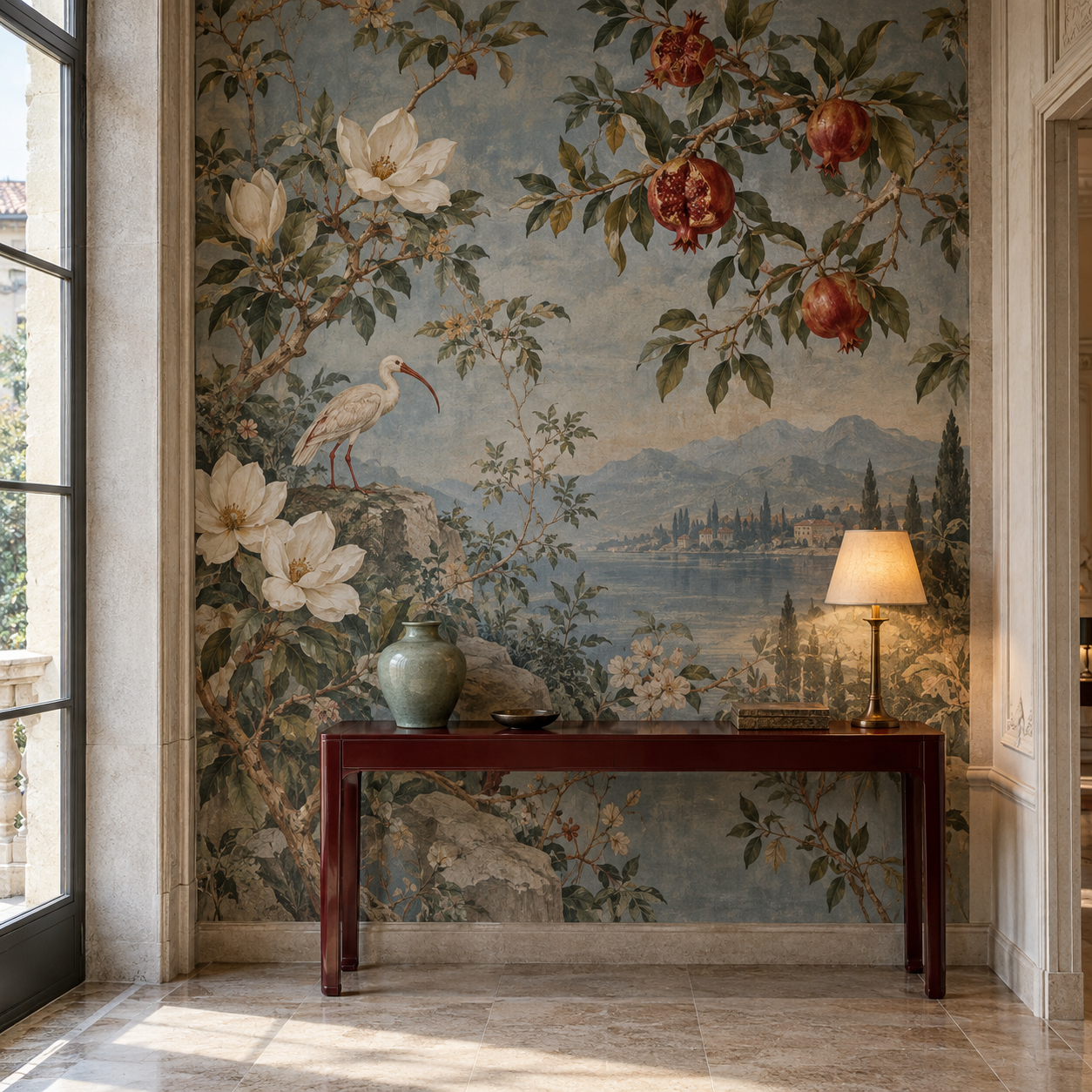
My dears, let us begin with a small confession: for years, we have been guilty of looking straight ahead. We have admired the grand scenic wall, the chinoiserie salon, the painted garden unfolding behind a sofa, the panoramic jungle turning a dining room into a stage set for some exquisitely improbable adventure. We have praised the wall, dressed the wall, worshipped the wall. And rightly so. A fine mural has the power to dissolve architecture and replace it with atmosphere. But what of the ceiling? Ah, the poor ceiling. So often left in white anonymity, treated as a polite afterthought, a blank lid placed upon even the most imaginative room. Yet any set decorator, any theatre designer, any old-world architect worth their salt knows the truth: the ceiling is not a lid. It is the sky of the room. It is the last surface the eye discovers and the one that can change everything. Today, the ceiling mural is returning as one of the most deliciously theatrical gestures in luxury interiors. Not as a gimmick. Not as an eccentric flourish for the overly decorated. But as the natural next chapter in the art of immersive living. The room no longer stops at eye level. It rises, blossoms, opens, glows. The fifth wall has awakened.
The Ceiling as Scenography
Imagine the scene. A dining room wrapped in a delicate chinoiserie landscape. Birds drift through flowering branches along the walls. The furniture is low-lit, the silver is ready, the glasses catch the candlelight. Then, just as the guest settles into the room, the eye lifts. Above, the branches continue, or perhaps the scene opens into a painted sky. Suddenly the room is no longer decorated. It is complete. That is the great secret of the ceiling mural. It does not simply add more pattern. It changes the room’s direction of travel. A wall mural draws us outward, into a landscape, a garden, a ruin, a forest, a faraway riverbank. A ceiling mural draws us upward. It gives the room breath. It turns architecture into a small cosmos. In a bedroom, it can feel protective, like sleeping beneath a painted canopy. In a dining room, it can bring splendour without crowding the walls. In an entrance hall, it makes arrival feel almost ceremonial. In a powder room, it creates that delightful jewel-box shock: one enters a modest little space and discovers, above one’s head, the heavens. It is an old trick, of course. The painted ceiling belongs to palaces, churches, villas, theatres, and grand hotels. But its return today feels wonderfully intimate. We are no longer speaking only of frescoes in vast halls. We are speaking of papers, panels, hand-painted grounds, custom-made scenic ceilings, printed skies, ornamental trellises, tented illusions and gilded canopies. In other words, the theatre of the ceiling has entered the private home.
The Houses That Still Look Up
Some of the great decorative houses understand this instinct beautifully. Iksel is perhaps one of the clearest examples, with a dedicated ceiling collection conceived to give the room a true third dimension, whether through sky-like openness or a more enveloping decorative effect. Zuber, that venerable French house of scenic wallpaper and historical craft, also proposes ceiling designs, reminding us that the ceiling belongs naturally to the same family as the panoramic wall: both are tools for extending the room beyond its physical limits. Then there is de Gournay, whose language of luxury has always understood the room as an artistic whole. In its universe, a ceiling may become a luminous surface, a gilded canopy, a continuation of a hand-painted decorative scheme, the sort of detail that makes the entire atmosphere feel more rarefied. Fromental, too, has shown how the ceiling can become part of a fully composed decorative world, with hand-painted designs used overhead so that the wall, the light fixture and the ceiling all enter the same choreography. Gracie, known for its hand-painted scenic wallpapers and custom decorative work, also belongs in this conversation, particularly when a project calls for a bespoke ceiling treatment, metallic ground or painted extension of a room’s decorative narrative. These houses matter because they treat the ceiling not as an afterthought, but as a legitimate field of composition. Not every wallpaper should be asked to climb overhead. The best ceiling murals are not merely wall designs placed horizontally; they are conceived with the strange, magical fact of looking up in mind.
The Many Moods of the Fifth Wall
The ceiling mural is not one idea. It is a whole repertoire. There is the sky ceiling, perhaps the most poetic of all: clouds, birds, drifting light, a blue that feels almost breathed onto the surface. In the right room, it creates an extraordinary sense of release. A low ceiling feels higher. A formal room feels softer. A bathroom becomes a tiny open-air pavilion. Then there is the garden ceiling: trellis, vine, blossom, branch. This is particularly enchanting when the wallcovering below already contains foliage. The eye follows the stems upward and suddenly the ceiling becomes a pergola. One thinks of winter gardens, conservatories, faded villas, the romance of dining beneath leaves without the inconvenience of weather. The tented ceiling belongs to another world entirely. It conjures pavilions, Ottoman interiors, desert encampments, silk-lined boudoirs, rooms made for private conversation and low lamplight.
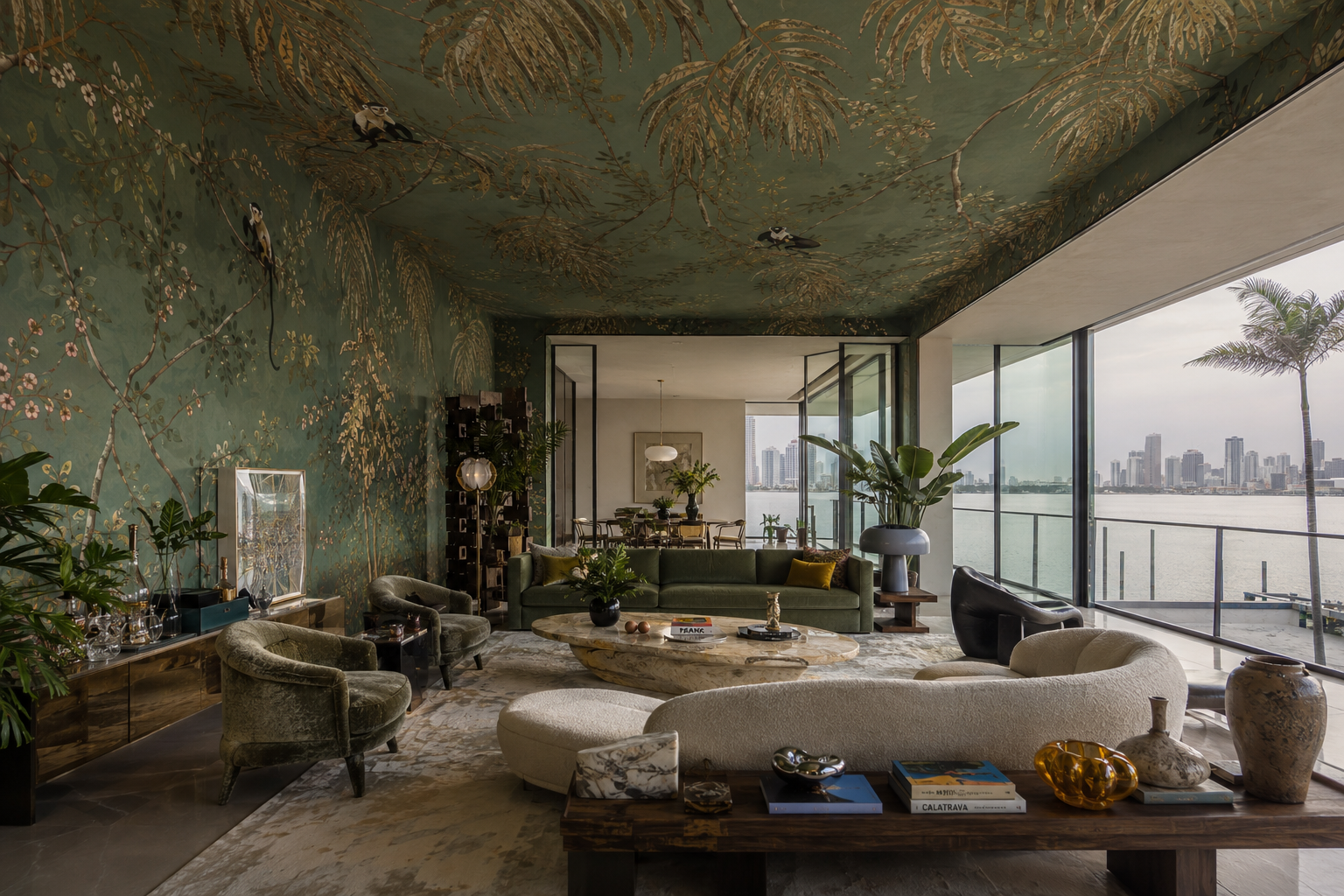
It is theatrical, yes, but also strangely intimate. A tented ceiling lowers the emotional temperature of a room in the most seductive way. It gathers the space around you. The ornamental ceiling is grander, more architectural: medallions, borders, stars, coffers, Renaissance geometry, Islamic pattern, neoclassical grisaille. This is where the ceiling begins to behave like architecture, even when the architecture itself is plain. A simple modern box can acquire lineage. A new apartment can suddenly feel as if it has inherited something. And finally, there is the gilded or metallic ceiling, the most dangerous and the most divine. Dangerous because it can so easily slip into vulgarity if handled without discipline. Divine because, when done well, it does not shout. It glows. It catches the evening light. It makes candle flames multiply. It turns the room into a private jewel.
Where Ceiling Murals Work Best
One might assume that a ceiling mural requires a palace. Mais non. In fact, some of the most successful applications happen in rooms of modest scale. A powder room is a perfect candidate. Small spaces forgive bold gestures. The ceiling becomes a surprise, almost a secret. Guests open the door expecting usefulness and find theatre. A dining room is another natural home. People linger there. They lean back. They look up between courses. A ceiling mural gives the dinner a setting, a canopy, a memory. Bedrooms, too, are wonderfully suited to the idea, though the treatment must be tender. No violent drama above the bed, please. A bedroom ceiling should not attack the eye. It should hover. Soft clouds, pale branches, a quiet trellis, a misty grisaille. Something that greets the morning gently. Entrances and stairwells offer a more public kind of drama. There, the ceiling mural becomes part of arrival. It says: this house has imagination. This house has confidence. This house has not forgotten to look upward. Even a corridor, that poor neglected passage between more important rooms, can become extraordinary when the ceiling is treated as a ribbon of sky, ornament or painted architecture. A ceiling mural does not need an enormous room. It needs conviction.
The Rules of Elegance
Now, a warning from the theatre: more scenery does not always make a better stage. A ceiling mural must be composed with the room, not merely applied to it. The cornice matters. The lighting matters enormously. A central pendant, a flush mount, a chandelier, or a lantern can either ruin the illusion or become its sun, moon, or axis. Scale is equally important. A large pattern on a low ceiling can feel oppressive if the colour is too heavy. A tiny repeat on a grand ceiling can look nervous. Borders can help tremendously, giving the design a frame and allowing the central field to breathe. And then there is the question of the walls. Sometimes the ceiling should be the star and the walls should retreat into plaster, silk, limewash, or a quiet texture. Sometimes the ceiling should complete a full scenic envelope, as with coordinated scenic and ceiling designs. The trick is not to ask every surface to sing the aria. Someone must carry the melody; someone else must provide the harmony. This is where the best wall mural brands distinguish themselves: Iksel, Zuber, de Gournay, Fromental and Gracie all understand, in different ways, that a ceiling treatment must answer the architecture of the room, not simply cover it.
Why It Feels So Right Now
The return of the ceiling mural speaks to a wider hunger in interiors: the desire for rooms with atmosphere, not just taste. We are tired of spaces that look assembled from admirable individual choices but do not amount to a world. A mural, especially one that climbs or opens overhead, gives a room unity. It offers a point of view. It also brings back a certain courage. To decorate the ceiling is to admit that beauty deserves effort. It says one has considered not only what is directly visible, but what is discovered slowly. There is something wonderfully luxurious in that delay. The best interiors do not reveal themselves all at once. They reward attention. And perhaps that is why the ceiling mural feels so emotionally powerful. It returns wonder to a place we had stopped expecting it. We look up and the room answers.

About the author: Geneviève
Born in the US to a French mother, Geneviève spent decades as a sought-after set decorator for European film and theatre productions, developing a storyteller’s eye for how environments shape narrative. Her extensive career demanded meticulous visual research into historical periods and translating abstract concepts into tangible, atmospheric sets – skills now focused on analyzing the impact of exceptional wallcoverings. Preferring quiet observation after years of collaborative, often uncredited, work, she now shares her unique perspective on visual drama and how murals act as compelling characters… Read more