The Dinner Party Landscape: Luxury Wall Murals for Dining Rooms
By Noora Al Hashemi · Published July 20, 2026
The Dining Room Is a Room Again
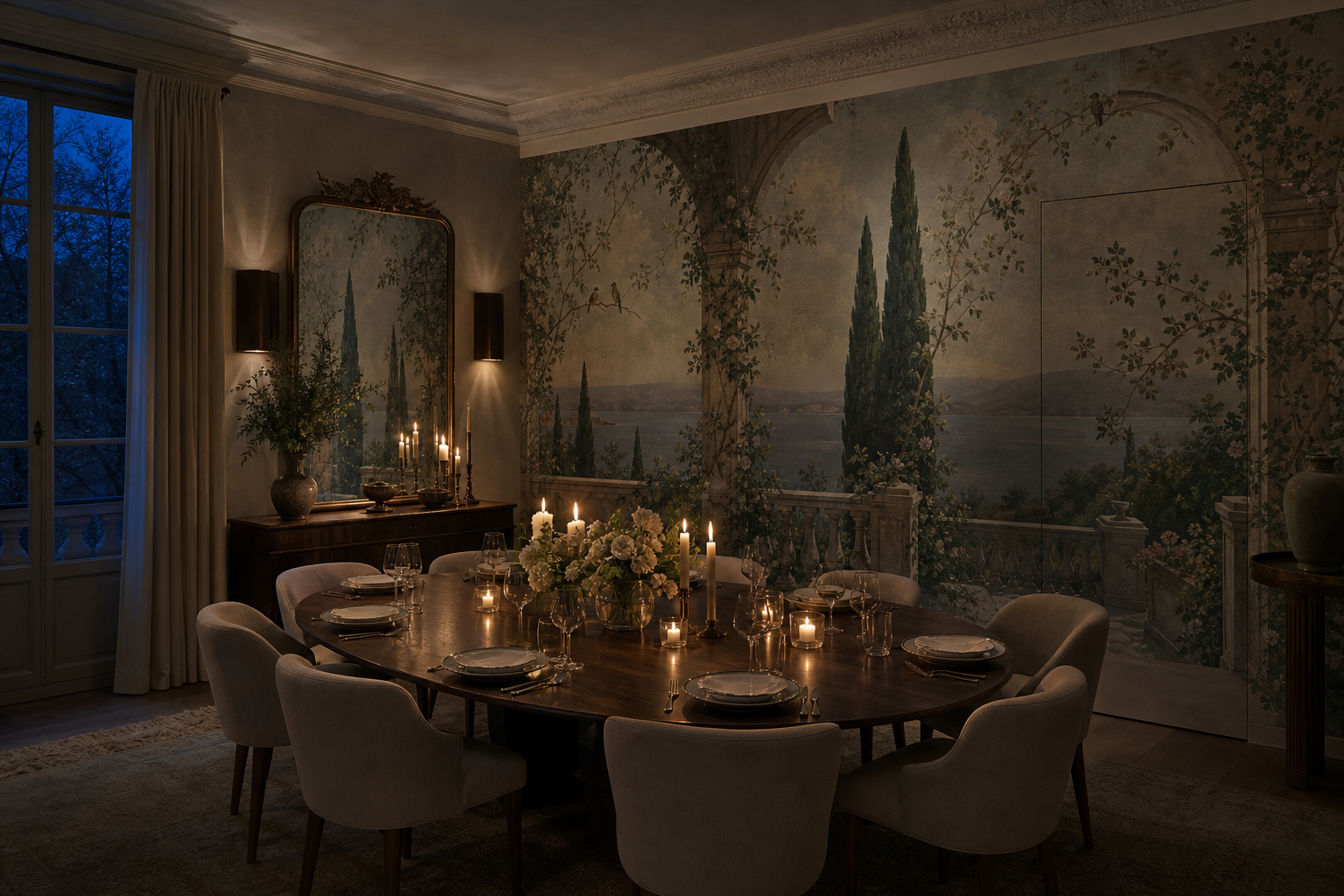
A luxury wall mural for a dining room works best when it makes the meal feel more intimate, not more decorated. The finest examples give the table a setting: a garden at dusk, a river beyond a balustrade, a pale architectural fantasy, a grove that seems to continue beyond the candlelight. The mural should support conversation, flatter faces, absorb light beautifully and make guests want to remain at the table longer than they intended.
That last point matters. Dining rooms are returning to serious design conversation because people are using them again, not as stiff ceremonial rooms, but as places for connection. ELLE Decor’s 2026 dining room report describes the renewed appetite for real, defined dining rooms, rooms with purpose, mood and enough presence to make dinner feel considered. For those of us who think about atmosphere professionally, this is a meaningful shift. A dining room is no longer the neglected space between kitchen and salon. It is becoming a destination.
This is precisely where luxury wall murals for dining rooms earn their place. A mural can give a room the concentration that open-plan living often dissolves. It encloses without heaviness. It gives guests something to enter, not merely somewhere to sit. At its best, it creates the emotional equivalent of a private restaurant one never has to leave home to find.
Begin With the Evening, Not the Wall
The first mistake is to begin with the blank wall. Begin instead with the evening. How does the room behave at seven-thirty, when the first guest arrives? Where is the tray set down? Where does one stand with a glass before sitting? Which wall is seen from the doorway, which from the host’s chair, which in the mirror after the candles are lit?
A dining mural is not viewed like a painting in a gallery. It is seen through glassware, across shoulders, above flowers, behind the host, reflected in a sideboard mirror, softened by low light and interrupted by the practical objects of hospitality. The design must therefore be generous enough to survive partial views. A single perfect focal point hidden behind a tall arrangement is not a composition; it is a missed opportunity.
I like to map the room as a sequence. Arrival view first. Seated view second. Reflected view third. Late-evening view, when only candles and sconces remain, last. This is the hospitality habit speaking, perhaps, but it is useful. The mural should improve each phase of the evening. If it only impresses in a daylight photograph, it has not yet done its work.
Choose a Scene That Can Sit at the Table
Not every mural belongs in a dining room. The table imposes a particular kind of intimacy. Guests are close to one another, close to the wall, and often seated for hours. A mural that is thrilling in an entrance hall may become tiring over dinner. A jungle that works in a bar may feel too restless beside porcelain and wine. A tiny repeat may become nervous behind chair backs. The room asks for atmosphere with discipline.
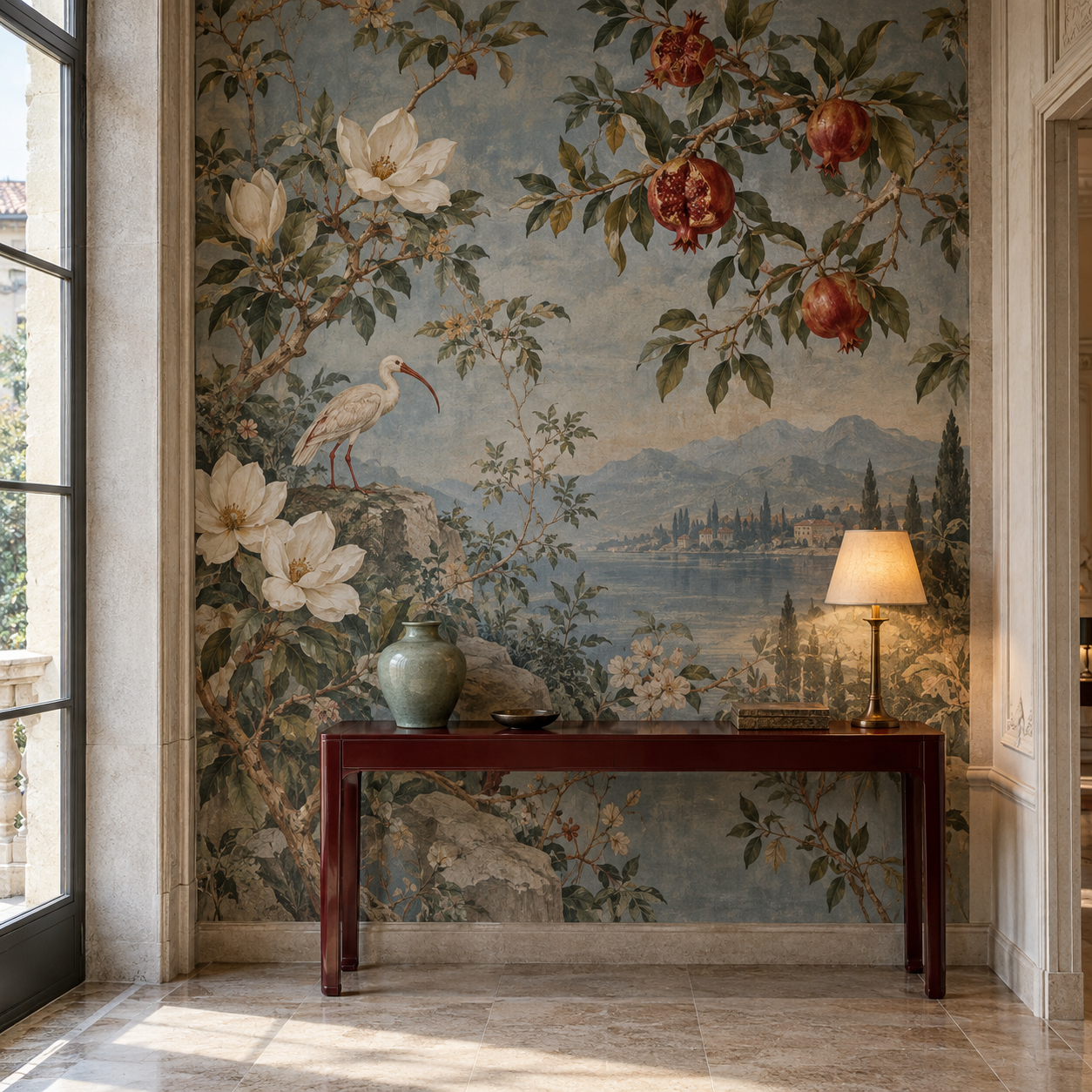
Landscape is often the most natural language because it gives the table air. A low horizon, distant water, a garden wall or a misted valley can make even a compact room feel more breathable. Architectural scenes are equally persuasive: loggias, colonnades, ruins, terraces and imagined pavilions give structure to the dining ritual. Chinoiserie can be exquisite when the branches and birds are scaled so they drift around the diners rather than perch busily above every plate. Grisaille is the great quiet luxury, especially for rooms where the food, flowers and guests should carry the colour.
The subject should be chosen for the kind of hosting the room supports. A formal dining room may accept a grander panoramic sequence. A family dining room needs softness and resilience. A city apartment dining corner may need depth more than drama. A country house dining room may want a mural that feels inherited, even when it is newly installed. The question is not which scene is most beautiful in isolation. It is which scene will sit well at the table.
Scale, Candlelight and the Question of Distance
Candlelight is a severe editor. It rewards texture, depth and warmth, and it punishes harsh contrast. A mural with too much white can glare under sconces; one with too much darkness can vanish by dessert. Metallic grounds may be magical, but only when used with restraint and tested under the actual lighting. Silk can glow exquisitely. Matte paper can feel more relaxed and painterly. Embroidery can add extraordinary depth but asks for a calm supporting cast.
Scale is equally important. The seated eye line changes everything. Motifs that look elegant on an elevation may land awkwardly behind heads. A bird can appear to sit on a guest’s shoulder. A figure may seem to join the dinner uninvited. A tree trunk can divide the host from the room. Before approving a design, draw the chair backs, sideboard, mirror, sconces, picture lights and flower height onto the elevation. Then imagine the room occupied.
House Beautiful’s 2026 dining room trend coverage notes that designers are still embracing dining-room murals, particularly when large continuous spans allow the composition to breathe and when hidden storage or jib doors are handled deliberately. That point is important. A dining room usually needs casegoods, doors and service access. The mural must not pretend these practicalities do not exist. It must choreograph them.
Let Doors and Storage Disappear Gracefully
The most elegant dining rooms often contain secrets: a jib door to a pantry, a concealed drinks cabinet, a shallow dishware cupboard, a service door, a panel that opens only when the evening requires it. A mural can make these elements disappear, but only if the panel layout is planned with unusual care.
Door edges should not cut through the most delicate passage of the scene. If a hidden cabinet interrupts the mural, give it foliage, sky, water or architectural texture rather than a face, bird or central tree. Hinges, reveals and handles need to be considered early. A beautiful mural badly sliced by hardware is not discreet; it is simply wounded.
This is where the dining room connects with our earlier thoughts on murals that announce arrival. Both rooms depend on the first view. But a dining room adds the pleasure of repeated looking. Guests have time to notice how the branch crosses the corner, how the door disappears, how the scene continues behind the sideboard. Quiet continuity is more luxurious than obvious display.
Which Mural Language Belongs at Dinner?
Different mural houses bring different manners to the table. De Gournay is compelling when the brief asks for hand-painted narrative, especially in rooms where birds, branches, silk grounds or metallic detail can respond to candlelight. Zuber offers historical authority and the grandeur of scenic paper as true decorative architecture. The Cooper Hewitt, Smithsonian Design Museum describes one Zuber scenic as a block-printing marvel of 32 panels, 360 colours and 2,300 woodblocks; that kind of making carries a gravity that a dining room can absorb beautifully.
There is also a particularly resonant precedent in the White House. The White House Historical Association records Zuber’s circa-1852 panoramic paper Views of the American War of Independence in the President’s Dining Room, installed during Jacqueline Kennedy’s restoration. It is a useful reminder that scenic wallpaper has long belonged to rooms of ceremony, conversation and national memory, not only to drawing rooms.
For a softer, more transported atmosphere, Ananbô’s painterly panoramas can be very persuasive, particularly when the client wants landscape as dream rather than declaration. Pierre Frey may bring archival wit or a stronger textile conversation. Nobilis and Elitis can be excellent when texture and restraint matter more than story. The house matters, certainly, but the dining ritual matters more. Choose the mural language that supports how the room will be used when the glasses are full and the lights are low.
Specify for Chairs, Wine, Warmth and Time
Dining rooms are practical spaces pretending, very successfully, to be romantic ones. Chairs scrape. Wine is poured. Platters move. Children sometimes appear where adults imagined only perfect guests. A wallcovering specification must respect all of this.
Begin with the lower wall. Chair rails, dado heights and wainscot can be friends to a mural because they protect vulnerable areas and give the composition a natural base. If the mural descends to the floor, choose the ground and finish with impact and cleaning in mind. In a room with upholstered chairs, specify enough clearance so backs do not constantly rub the wall. Around a bar cabinet or buffet, consider where hands will touch the surface. Near candles, ensure sconces and table flames are set at a safe and sensible distance, and keep delicate papers away from repeated heat exposure.
Lighting samples are non-negotiable. Look at the mural by daylight, under warm dimmed light and with candles on the table. Test the ground beside the timber, stone, metal, chair fabric and table linen. The colour that feels subtle at noon may become flat at night; the blue that seems romantic in a sample may turn cold beside food. Dining rooms need flattering light. If the mural makes people look tired, it does not matter how beautiful the landscape is.
The Room Guests Remember After Dessert
The most memorable dining rooms do not merely display taste. They change the tempo of the evening. Guests lower their voices slightly. They notice the view that is not a view. They remain for another glass because the room seems to have made room for time itself.
This is the gift of a well-chosen dining mural. It gives hospitality a visible atmosphere. It can make a new room feel established, a small room feel deeper, a formal room feel warmer, a practical room feel almost ceremonial. It also offers the rare luxury of privacy. Unlike a restaurant mural, which must impress strangers night after night, the private dining mural becomes part of a family’s rituals: birthdays, late suppers, difficult conversations, generous ones, the ordinary Tuesday meal that suddenly feels more gracious.
So choose slowly. Study the room occupied, not empty. Consider the first arrival and the last candle. Place the doors, chairs and lights on the elevation. Ask whether the scene has enough silence for conversation and enough beauty for memory. When the answer is yes, the dining room becomes more than a place to eat. It becomes the landscape of the evening.