The Human Hand Is the Luxury: Hand-Painted Wall Murals in the Age of AI
By Seraphina Bellweather · Published September 14, 2026
A Prompt Can Invent an Image, Not a Lineage
There is a new sort of wall in circulation: impeccably composed, atmospherically lit, botanically persuasive and born before lunch. It arrives from a prompt with its ruins handsomely ruined, its peonies open at exactly the right degree of romance, its mist obligingly arranged behind the console table. One cannot deny the speed. One should, however, resist confusing speed with authorship.
Hand-painted wall murals matter more in the age of AI, not because every digital tool is vulgar and every brushstroke holy, but because luxury depends upon distinctions. Who made this image? From what source? On which ground? By what sequence of decisions? Can its composition be altered intelligently for a doorway, a cornice, a client’s private symbol or the changing light of a room? What will happen when pigment, silk, paper, adhesive and time begin their long conversation?
A prompt can invent an image. It cannot, by itself, supply lineage, material judgement, apprenticeship, accountability or the cultivated resistance of another human mind. These are not sentimental extras. They are part of what the designer is specifying.
The Human Hand Is Not a Filter
The phrase hand-painted is frequently used as if it described a visual effect. It does not. A filter can imitate feathered edges, pigment blooms, dry-brush drag, foxing, paper grain and the soft misregistration of an old block print. A photograph can make those effects extremely convincing. The hand is not the appearance of irregularity. It is a process of attention.
The Victoria and Albert Museum’s history of wallpaper follows the medium from labour-intensive hand production through block printing and industrial machinery. That history is not a simple morality tale in which machines spoiled everything. Mechanisation expanded access and created its own design languages. Yet it also made a crucial distinction visible: a surface may carry the look of labour without carrying the decisions of labour.
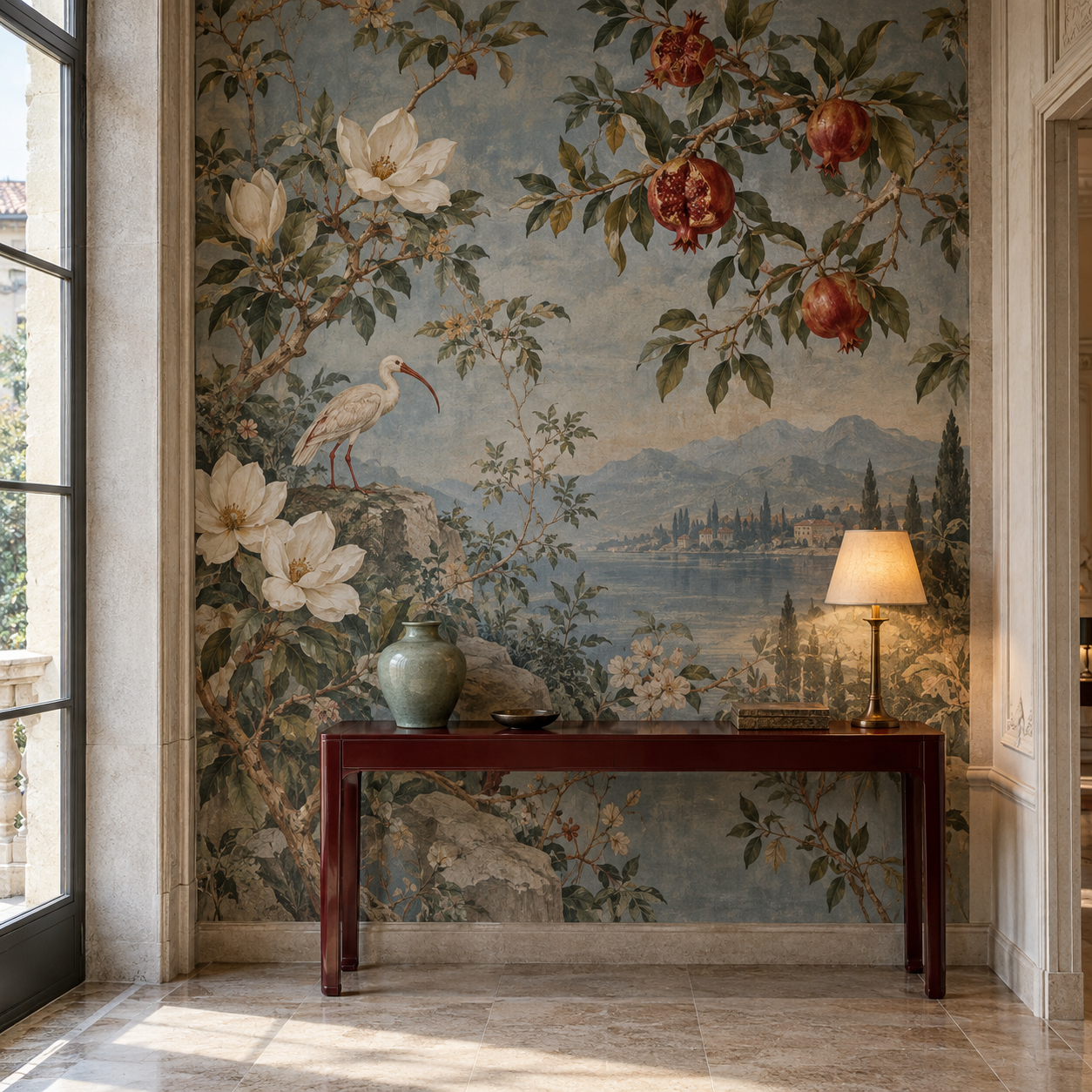
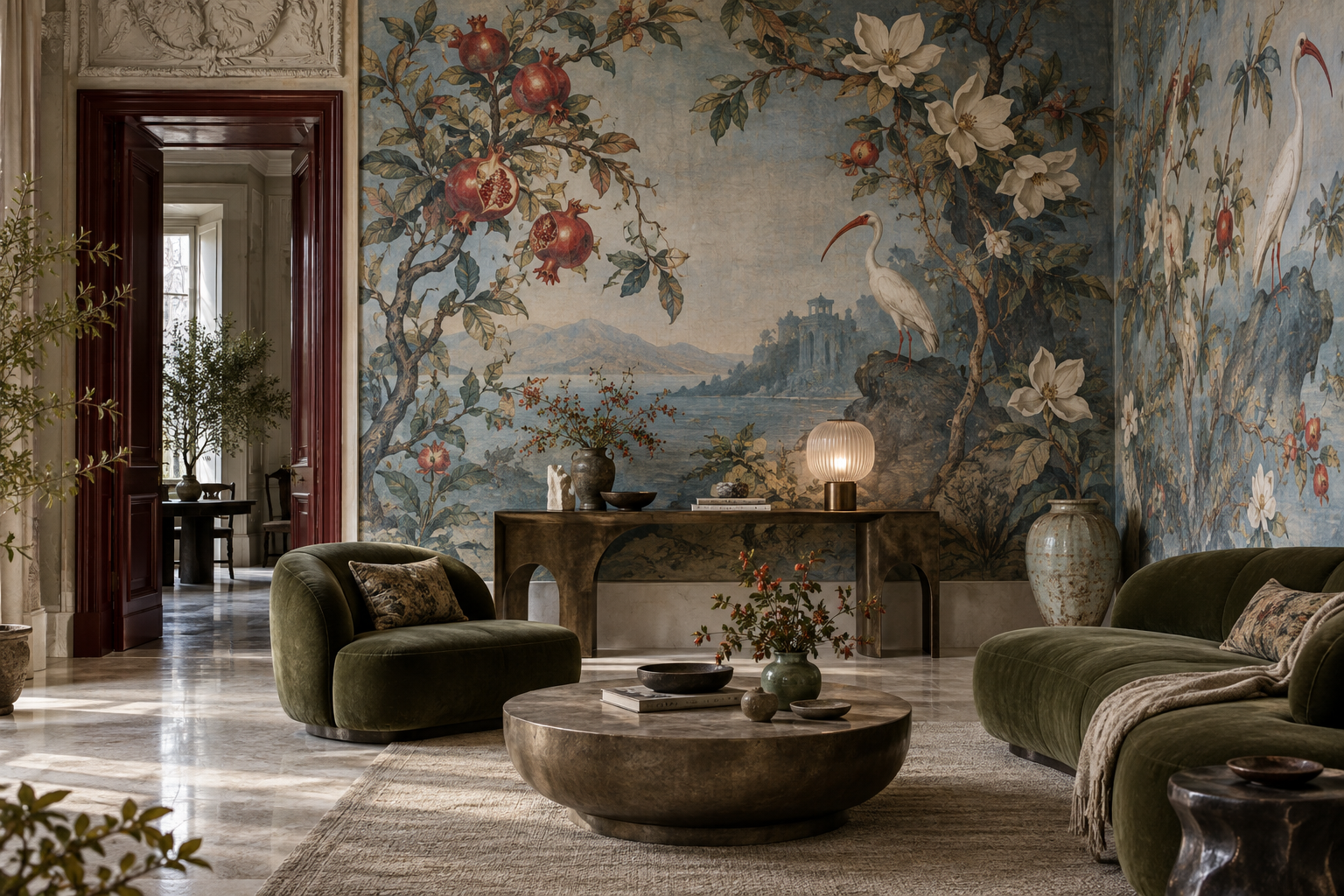
In a genuine hand-painted mural, pressure changes because the artist responds to the ground. A leaf darkens because the composition needs weight at that point, not because a texture map repeats every thirty centimetres. A bird may move because the door changed. A cloud may be thinned because the room is lower than the elevation suggested. The work is not merely rendered. It is negotiated.
What Designers Are Really Buying
When designers commission hand-painted wall murals, they are not buying a higher-resolution image. They are buying a chain of custody for taste. There is a named studio, an archive, a design hand, a sample history, a colour decision, a painter or team of painters, a production record, a panel sequence and someone who can answer when the architecture misbehaves.
This is why UNESCO’s account of traditional craftsmanship is so useful. It places the emphasis not only on finished objects but on the knowledge and skills that must be transmitted so a craft can remain alive. Apprenticeship, practice and livelihoods are part of the cultural value. The luxury client who chooses serious craft is therefore doing more than acquiring evidence of handwork. The commission helps maintain the conditions under which skilled work can still be learned and made.
There is also a quieter pleasure. One lives differently with an object whose making can be understood. The wall acquires biography. Its beauty is not exhausted by first sight because one can return to the decisions embedded in it: the layered ground, the changed branch, the minute correction, the section where a broad wash gives way to a line placed with almost forensic calm.
Irregularity Is Evidence
Perfection is a dangerous word in decorative art. It often means that variation has been tidied away until the surface no longer gives the eye anything to investigate. The finest handmade work is exact, but not sterile. Its irregularities are governed. They reveal rhythm rather than error.
At Paris Deco Off 2026, the most interesting reports were not about one fashionable motif but about tactility, marquetry, beading, relief, embroidery and surfaces that remained visibly rooted in making. The current appetite for the human-made is not an invitation to fetishise wobble. It is a reaction against decorative sameness: the immaculate, frictionless image that seems designed to satisfy an algorithm before it satisfies a room.
A designer should therefore inspect variation rather than merely celebrate it. Does the painter’s handling give life to leaves, water, cloud and distance? Are repeated motifs adjusted with intelligence? Does the ground show depth beneath the image? Are transitions graceful from panel to panel? An irregular seam is not artisanal charm. A poor drawing is not soulful because it took longer. The hand earns its authority through judgement.
Material Thinks Back
A screen is obliging. Silk is not. Nor are handmade paper, gilded grounds, metallic leaf, mineral pigment, embroidery, relief, lacquer or the peculiar wall that has remained slightly damp since 1894. Material thinks back. It absorbs, resists, stains, flashes, dulls, stretches and records touch.
This resistance is precisely why hand-painted wallpaper can possess such depth. At de Gournay, hand painting and embroidery are not abstract style labels; they are processes applied across distinct grounds and materials. Fromental’s bespoke services make an equally important point: a printed paper may begin with a hand-painted original, while digital production can be layered with hand painting, gilding or embroidery. The real question is not whether a computer ever entered the building. It is where material intelligence and human judgement remain active.
For specifiers, the ground must be treated as part of the image. Silk changes with daylight and viewing angle. A matte paper can hold shadow with great dignity. Metallic surfaces may come alive at dinner and become tiresome under a careless downlight. Relief catches grazing light but also catches dust. Before approving anything, place the full sample vertically in the real room, beside the actual stone, timber, textile and lamp. A JPEG has never met your client’s north-facing window.
Bespoke Means Conversation, Not Custom Sizing
The word bespoke has been diluted by menus. Choose a background colour, reverse the drawing, enter the wall dimensions and one is invited to feel like a patron of the arts. These options can be useful, but they are not the whole meaning of commission.
True bespoke work permits a conversation that changes the composition. The artist or atelier can respond to architecture, sightlines and the client’s story. A tree may be redrawn so its canopy gathers above a sofa. A distant pavilion may be moved away from a door swing. Flora can be selected for personal or regional meaning. A horizon can be lowered to give a dining room more air. A family emblem can be absorbed quietly into the scene without turning the wall into heraldic merchandise.
Our guide to specifying bespoke wall murals begins with elevations, substrate and installation because romance without measurement is merely expensive optimism. Hand painting adds another essential participant to that process: the artist. The best result is not the designer dictating every leaf. It is a disciplined exchange in which architecture, client, artist and material are all allowed to improve the original idea.
Provenance Has Entered the Specification
AI has made provenance a practical design question. The issue is not solved by asking whether a tool was used. Photography, scanning, digital drawing, colour separation and large-format printing have belonged to sophisticated wallcovering production for years. The useful questions are more precise: What is the source artwork? Who created it? What rights accompany it? Which parts are generated, drawn, painted, printed or finished by hand? Can the studio document the commission and reproduce a damaged panel later?
WIPO’s continuing work on generative AI and intellectual property reflects how unsettled authorship and ownership remain when systems augment or replace human creative work. Interior designers need not become copyright scholars, but they do need written answers. A mural occupies a large visual field, appears in professional photography and may become inseparable from a project’s identity. Ambiguous provenance is not a charming mystery when publication, licensing or replacement becomes necessary.
Record the approved artwork, creator or studio, permitted uses, custom elements, production method, edition or exclusivity terms where relevant, colour approvals and final panel map. If AI tools contributed, ask how and where. Transparency does not make a work lesser. Evasion does.
Let Technology Stay in the Studio
One need not choose between the quill and the server rack. Technology can be excellent company in a studio when it performs the tasks to which it is suited. It can test scale, organise colour variants, visualise a panorama around corners, map panels to elevations, archive revisions, simulate lighting, prepare print separations and help a client understand the difference between a sample and an enveloping room.
What it should not do is erase the authorship it assists. The strongest hybrid practices make the sequence legible. A hand-painted original can be scanned with extraordinary fidelity, adapted digitally for a room, printed on a chosen ground and then returned to the hand for gilding, overpainting, embroidery or local correction. This is not counterfeit craft. It is contemporary craft, provided each stage has a reason and the result is described honestly.
The distinction is between tool use and creative abdication. A designer may use an AI visualisation to test whether the room wants a forest or a shoreline. That image can begin a conversation. It should not automatically become the mural, especially when its botanical inventions, borrowed visual syntax and impossible spatial logic have never been examined by an artist who knows how a wall is actually read.
How to Specify Hand-Painted Wall Murals Now
A short specification checklist is useful. First, name the maker, source artwork and production method. Second, ask which stages are drawn, painted, printed, embroidered, gilded or digitally generated. Third, request a meaningful sample on the intended ground, large enough to judge line, wash, colour, sheen and variation.
Fourth, review full elevations with doors, windows, furniture, lighting, switches, sockets, cornices and sightlines. Fifth, mark motifs that must not be cut by seams, openings or joinery. Sixth, confirm revision rounds, colour approvals and who has authority to make compositional changes. Seventh, state rights, exclusivity and photography permissions in writing.
Eighth, coordinate substrate preparation, adhesive, installer, protection, lighting and cleaning. Ninth, keep final artwork references, panel maps, batch details and spare material for repair. Tenth, ask the least technical question and listen closely to the answer: who actually makes this? A serious atelier will not find the question insulting. It will usually be delighted that someone noticed.
Finally, light the installed mural with the same care described in our guide to wall mural lighting. The hand is often most legible at the edge of illumination, where wash, ground and minute relief stop behaving like a picture and begin behaving like matter.
The Wall Should Still Surprise Its Maker
The future of hand-painted wall murals will not be secured by pretending technology has not happened. Nor will it be secured by turning every brush mark into a luxury slogan. Craft survives when it continues to think, adapt, teach, employ, experiment and answer new rooms with more than inherited gestures.
The designer’s responsibility is discrimination. Choose the digital process when precision, reproduction or access makes it right. Choose the hand when judgement, material variation, revision, intimacy and lineage matter. Choose the hybrid when each method can be named and each improves the work. Refuse only the lazy fiction that all images become equivalent once they are beautiful on a screen.
A great hand-painted mural contains intention, but it also contains encounter: the moment pigment met silk, the moment the artist changed course, the moment the architecture demanded an answer that was not in the first drawing. That is why the wall continues to surprise. It was not merely generated to resemble a finished idea. It was made, and in the making it learned how to belong to the room.