The Light That Finishes the Wall: How to Illuminate Luxury Wall Murals
By Geneviève Ashworth · Published September 11, 2026
A Mural Is Not Finished at Installation
My dears, a luxury wall mural is not truly finished when the last panel is smoothed, the final edge trimmed and the installer steps away with heroic calm. It is finished later, when the light arrives and decides what kind of room the wall will become.
This is the point too many projects forget. A scenic mural can be selected with scholarship, printed or painted with delicacy, installed with devotion, and then ruined by a row of indifferent downlights that turn the whole thing into a flattened brochure. Or it can be half-hidden by a timid lamp plan, so that the client owns a private landscape but lives beside a shadowy rumour of one.
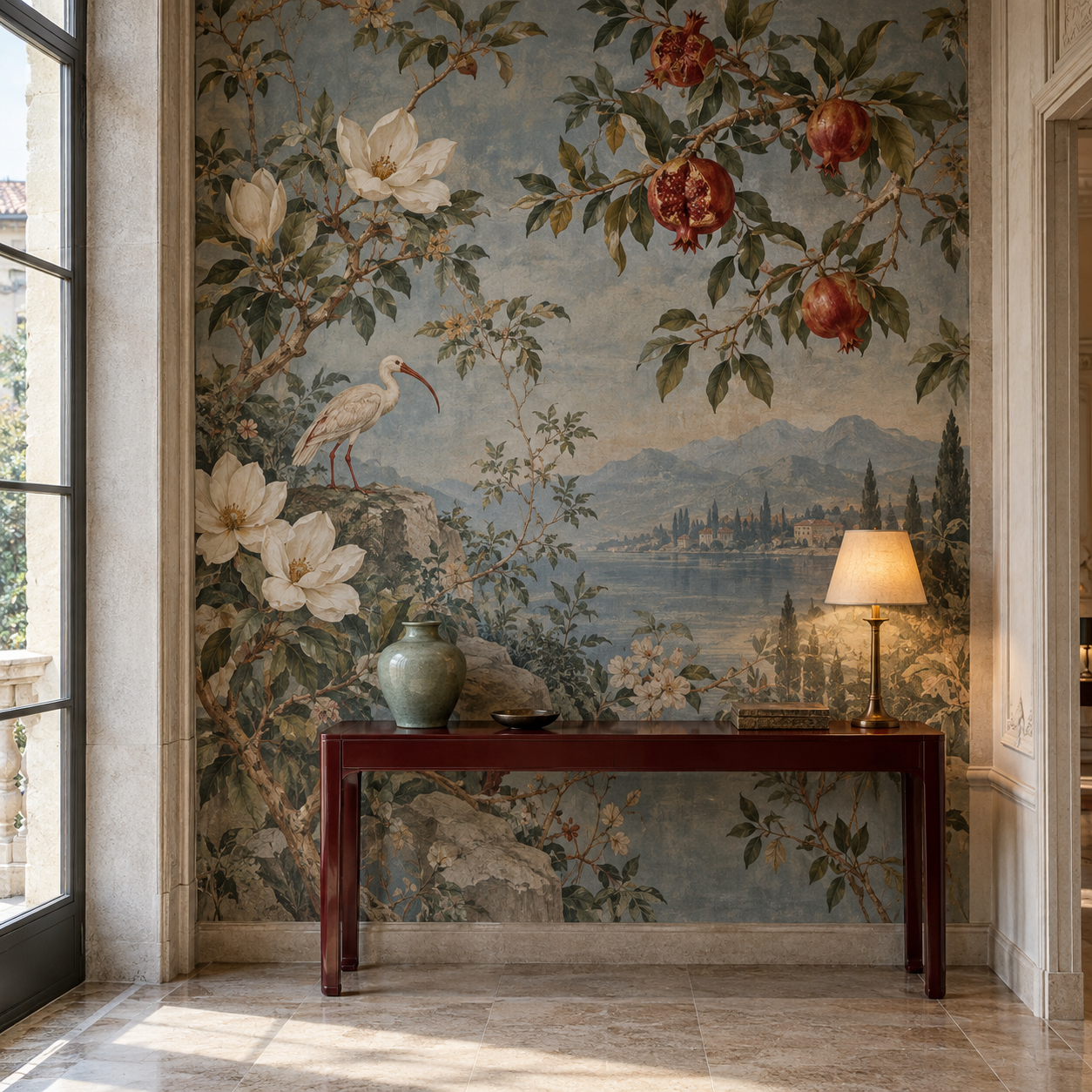
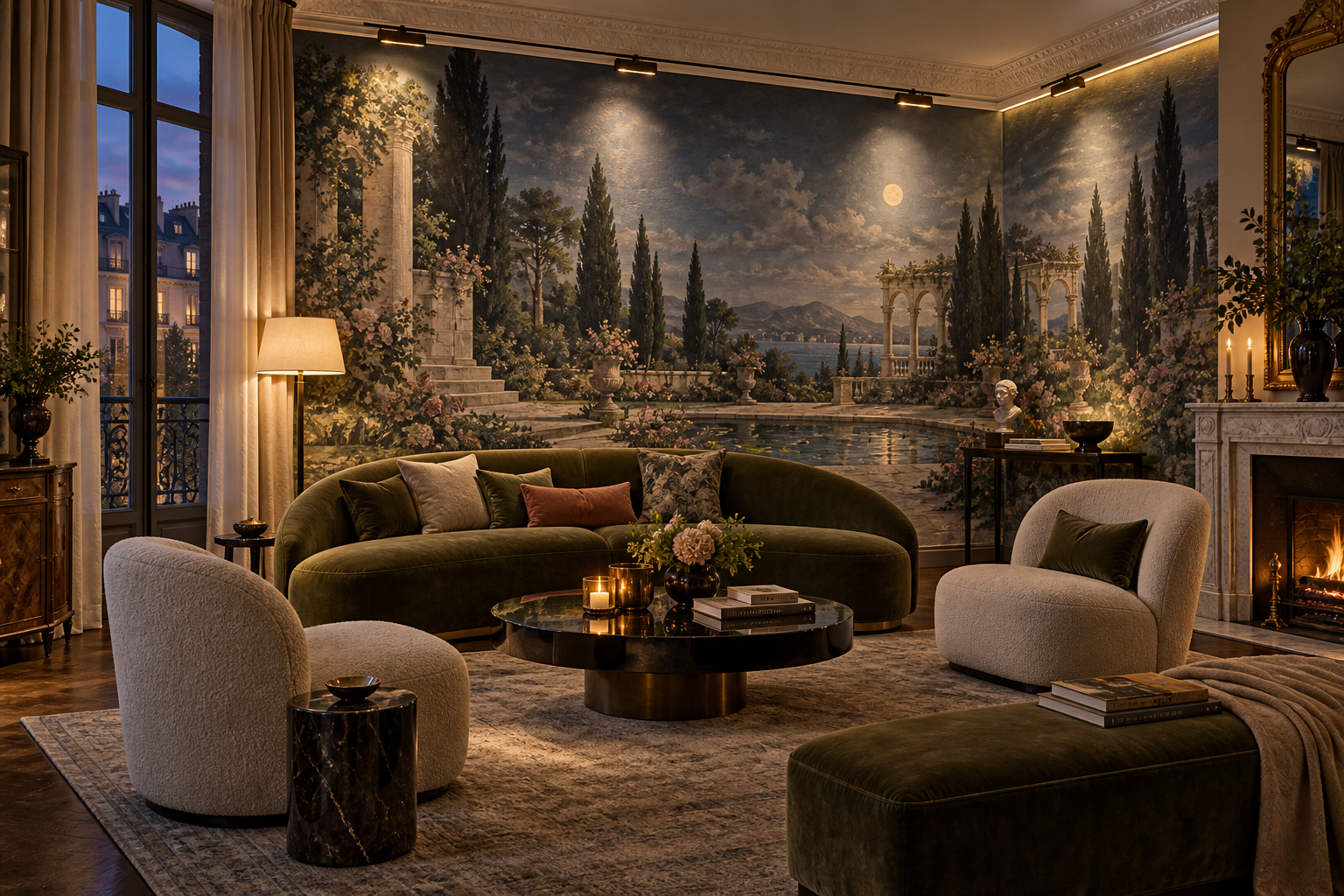
Wall mural lighting is not a technical afterthought. It is interpretation. It is the score under the scene, the candle just off camera, the difference between a painted garden that sits on the wall and one that seems to breathe behind the sofa. The finest murals need light with intelligence: enough to reveal detail, enough restraint to preserve mystery, and enough variation to let the room have an evening life.
The Return of Low Light, Properly Understood
It is no accident that the current conversation has turned toward low light. Livingetc’s recent piece on low-light rooms makes the useful distinction between atmosphere and simply stumbling about in decorative gloom. The best rooms are not dark because no one has solved the lighting. They are low-lit because someone has layered the light so carefully that the room can lower its voice without losing its function.
That is precisely the opportunity with murals. The wall should rarely be blasted evenly from ceiling to skirting like a retail display. It should have a principal wash, yes, but also pools of lamplight, reflected warmth, small shadows, and perhaps one discreet accent that finds a tree, a column, a moon, a bird, a ruin, a painted river. This is what makes a mural belong to life rather than to photography alone.
Low light also asks a designer to be honest about use. A dining room needs flattering faces. A study needs enough clarity for reading. A hallway needs safety. A bedroom needs softness. A hotel suite needs scenes: arrival, dressing, late room-service supper, morning curtains. The mural should participate in all of those states. A wall that only looks marvellous at one dimmer setting is not yet a room; it is a pose.
Wall Washing Is the Calm Establishing Shot
Wall washing is the civilized foundation. It gives a mural legibility without making it perform every minute. A good wall wash spreads light over the vertical surface with as little scalloping, glare and patchiness as possible. The eye should read the scene before it notices the instrument. In a luxury interior, the luminaire is rarely the protagonist; it is the stagehand in a beautiful jacket.
This is where early coordination matters. A track placed too close to the wall may create harsh ovals and a theatrical row of hot spots. A fitting placed too far into the room may throw shadows from people, flowers, chair backs and lamp shades. A cornice detail may conceal a linear source beautifully, or it may trap heat, reveal every ripple in the substrate and make maintenance an elegant nuisance.
The Illuminating Engineering Society’s Lighting Library is a reminder that good lighting design is a professional discipline, not a mood-board caption. For specifiers, the lesson is simple: bring the lighting designer into the mural conversation early. The wallcovering elevation, the furniture plan, the ceiling plan and the lighting plan should know one another before anyone falls in love with a printed sample.
Grazing Light Is Drama, and Drama Needs Manners
Grazing light is more dangerous, and therefore more tempting. It can be exquisite on a textured ground, a hand-painted silk, a grasscloth, a relief paper or a plaster-like scenic surface. It catches the tooth of the material. It makes a branch feel brushed rather than printed. It lets a matte sky hold small weather. Done well, it gives the wall a pulse.
Done badly, grazing light is merciless. It reveals every seam, every raised adhesive line, every imperfectly prepared wall, every small bruise beneath the paper. It can turn subtle texture into a forensic report. It can also make the mural too restless, so that instead of depth one sees a pattern of shadows imposed by the fixtures rather than by the artwork.
Use grazing light where the surface deserves it and the wall can bear it. Test it with the actual material, on the actual substrate if possible, at the intended distance and dimming level. If the mural is scenic and smooth, a gentle wash may be kinder. If the mural has hand, grain, silk, embroidery or mineral depth, grazing light may be the whisper that reveals its making. The point is not to dramatize everything. It is to choose where the drama belongs.
Colour Temperature Is a Casting Decision
Colour temperature is not a number alone. It is casting. Warm light can make a painted garden hospitable and a moonlit panorama intimate; too warm, and every blue collapses into brown. Cooler light can preserve clarity in a grisaille or architectural scene; too cool, and the room begins to feel like the lobby of a clinic that has read one design magazine too many.
For most residential and hospitality murals, I would begin by testing warm dimmable light in the evening and natural daylight by day, then judge the mural beside the real materials: walnut, bronze, linen, stone, wool, lacquer, paint, upholstery and human skin. The mural may contain colours that behave beautifully in the sample room but become sulky under the chosen lamp. The only honest test is the room itself.
Colour rendering matters as much as warmth. A scenic mural asks for greens that do not die, reds that do not shout, mineral blues that keep their intelligence, and skin nearby that remains alive. This is not fussiness. It is hospitality to the eye. If the light makes the wall expensive but the people tired, the light has failed.
The Beautiful Wall Must Also Survive
There is also the question of care. The Getty Conservation Institute’s museum lighting research is useful because it treats light as both necessity and risk. One lights an object in order to see it, but the act of lighting delivers energy to a surface, and that energy can contribute to change over time.
The Getty Museum explains this even more plainly in its article on why galleries are kept dim: light can fade colours, darken paper and cause permanent change. A private mural is not a museum manuscript, certainly, but many luxury wallcoverings still contain organic grounds, pigments, fibres, papers, adhesives, textiles or hand-applied finishes that deserve respect.
This does not mean living in the dark. It means specifying with proportion. Control UV where daylight is strong. Use dimming and scenes rather than one permanently high output. Avoid unnecessary overnight illumination. Ask the maker for care guidance. Consider the cumulative hours of light, especially in rooms with sun exposure or hotel corridors where the wall may be lit all day. Beauty should be visible, yes. It should also be allowed to last.
Daylight Is a Guest, Not a Servant
Daylight is the most seductive collaborator and the least obedient. Morning light may make a painted river shimmer. Afternoon sun may burn through a pale ground until the mural disappears. A north-facing room may give a grisaille extraordinary poise. A west-facing room may turn a delicate chinoiserie into a daily endurance test unless curtains, glazing, shades or the artwork itself have been considered properly.
The WELL Standard’s Light concept reminds us that light is not merely decorative; it affects visual acuity, glare, circadian rhythm and the body’s sense of time. Designers know this instinctively in good rooms. We feel it when breakfast light is kind, when a study clears the mind, when a bedroom becomes quieter as the lamps warm and the window darkens.
For murals, daylight should be choreographed rather than merely admitted. A sheer curtain can protect and soften. A lined curtain can create an evening reveal. Automated shades may be practical in a high-glazing project. A mural chosen for a bright room should not depend on fragile low-contrast subtleties that vanish at noon. Conversely, a dark mural in a dim room may need more than romance; it may need a serious lighting plan.
Which Mural Language Wants Which Light?
Different mural languages ask for different light. Ananbô-like landscapes, with their dream of distance and remembered travel, often want softness, a little haze, and a low horizon preserved from glare. They suffer when over-lit, because the dream becomes literal. De Gournay-style chinoiserie can be ravishing under warm, angled light, especially when silk or metallic grounds catch the evening, but it needs restraint so that birds and branches do not become jewellery under a shop window.
Zuber, with its scenic authority and historical gravity, deserves an almost architectural wash. Let the panorama read as sequence and space, not as a set of decorative incidents. Pierre Frey may tolerate more wit and textile play; its colours can often take a livelier lamp if the room is brave enough. Nobilis and Elitis, where surface, fibre and texture may carry the luxury, are frequently the houses that reward grazing light most clearly. Designers Guild may want colour to stay buoyant, which means testing lamps before trusting them.
The principle is not brand obedience. It is dramatic truth. Ask what the mural is doing. Is it extending the architecture, softening a bedroom, sharpening a salon, warming a corridor, dignifying a restaurant, disguising a door, giving a neutral room weather, or making a wall feel like memory? Then light that action. A stage set is never lit the same way for a confession, a ball and a farewell.
A Specifier's Checklist for Wall Mural Lighting
A practical checklist, then. First, put the mural elevation, lighting plan and furniture plan on the table together. Second, decide whether the wall needs a wash, a graze, accents, reflected lamplight or a combination. Third, test the actual sample vertically, in the actual room if possible, by day and by evening.
Fourth, check glare from seated and standing positions. A fitting that looks discreet in plan may shine directly into the eye from the sofa. Fifth, protect colour and material: ask about UV, heat, dimming, maintenance access, cleaning and expected exposure. Sixth, coordinate with curtains, shades, picture lights, wall lights, mirrors and art, because every reflective surface joins the conversation whether invited or not.
Seventh, set lighting scenes. Arrival, dinner, reading, cleaning, late evening and morning do not need the same wall. Eighth, photograph the room under the intended light before approving the final effect, but do not design only for the photograph. Ninth, leave instructions for the client and house staff. A beautiful lighting scheme can be undone by one switch habit. Tenth, sit in the room after sunset and wait until the wall stops performing. If it still holds the room, the light is right.
Let the Room Change After Sunset
The best wall mural lighting has a little modesty. It does not announce that it is clever. It lets the painted garden arrive slowly, lets the stone step emerge, lets the cloud darken, lets the branch pass through lamplight and shadow. It understands that luxury is often a matter of sequence: first the room, then the atmosphere, then the detail that rewards attention.
This is why light finishes the wall. Not because it corrects the mural, but because it releases it into time. Morning, noon, dusk, dinner, midnight: a great mural should not be one image fixed forever at the sample-table hour. It should change its mind with the room.
So choose the mural, yes. Choose the atelier, the ground, the colourway, the scene, the charming bird, the ruin, the sweep of distant water. But before you call the room complete, turn on the lamps. Dim them. Close the curtains. Let the wall have its evening. Only then will you know whether you have installed decoration, or whether you have made a place.