The Beautiful Risk: How to Specify Bespoke Wall Murals Without Losing the Room
By Seraphina Bellweather · Published August 31, 2026
Bespoke Is Not a Synonym for Improvised
There is a particular moment in a luxury interior project when the word bespoke begins to glow a little too brightly. Everyone in the room relaxes. The client imagines uniqueness. The designer imagines freedom. The supplier imagines possibility. Yet bespoke wall murals are not made successful by possibility alone. They are made successful by discipline.
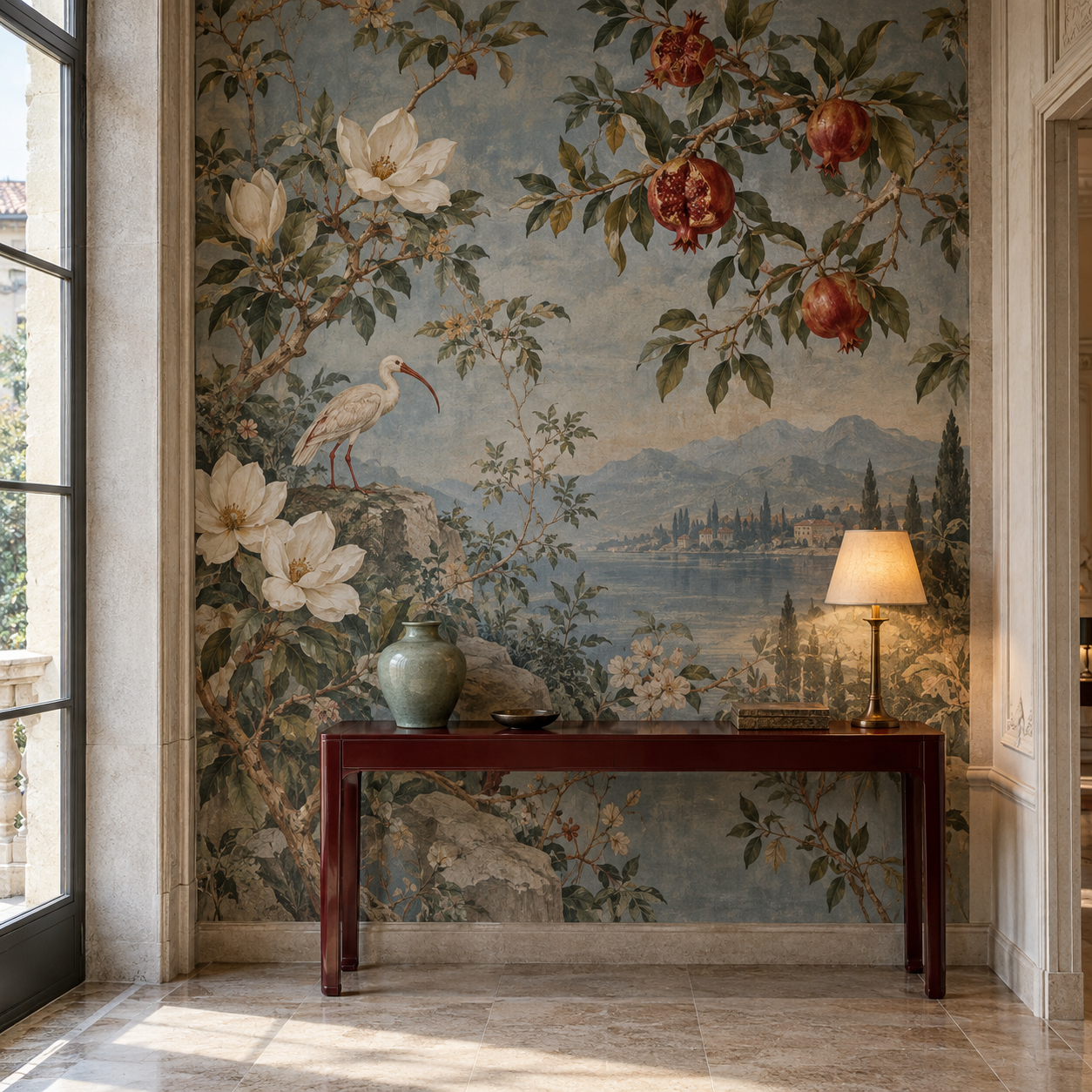
A custom mural can be one of the most generous objects in a room: a private landscape, a corrected proportion, a view invented where architecture withheld one, a record of taste that cannot be bought from a roll by the metre. It can also become an expensive argument with a doorway, a sofa, a damp wall, a sconce, a delivery date or a client who discovers too late that the bird she adored in the drawing now hovers at shoulder height during dinner.
This is the beautiful risk of bespoke wall murals. They promise freedom, but they reward precision. The designer’s work is not merely to choose an image. It is to translate atmosphere into measurements, substrates, samples, elevations, light, maintenance and time.
Begin Before the Pretty Drawing
The RIBA Plan of Work is useful here because it reminds us that a building project moves through stages: briefing, concept, spatial coordination, technical design, manufacturing, construction, handover and use. A mural belongs inside that rhythm. It should not drift in at the end like a charming guest no one has seated.
For interior designers, the equally practical BIID guidance on FF&E makes the point in another language: products, suppliers, scope, programme, suitability, sustainability and responsibilities must be identified early. A bespoke mural may feel artistic, but it is also a specified finish with procurement, liability, installation and aftercare attached.
The first brief should therefore be written before the first romantic sketch. What must the mural do? Extend a narrow room, soften new architecture, dignify a corridor, quiet a bedroom, give a dining room ceremony, conceal a service door, create memory for a hotel suite, or make a study less tyrannised by its screen? If the answer is only “make it special,” the project has not yet begun.
Scale Is a Contract With the Room
Scale is where many beautiful murals become foolish. A drawing may look exquisite on a table because it is being viewed by a pair of hands. A wall is viewed by bodies moving through space. It is interrupted by furniture, door casings, cornices, switches, window reveals, lamp stems, curtain stacks, headboards, radiators, cabinetry and the inconvenient truth that people are not transparent.
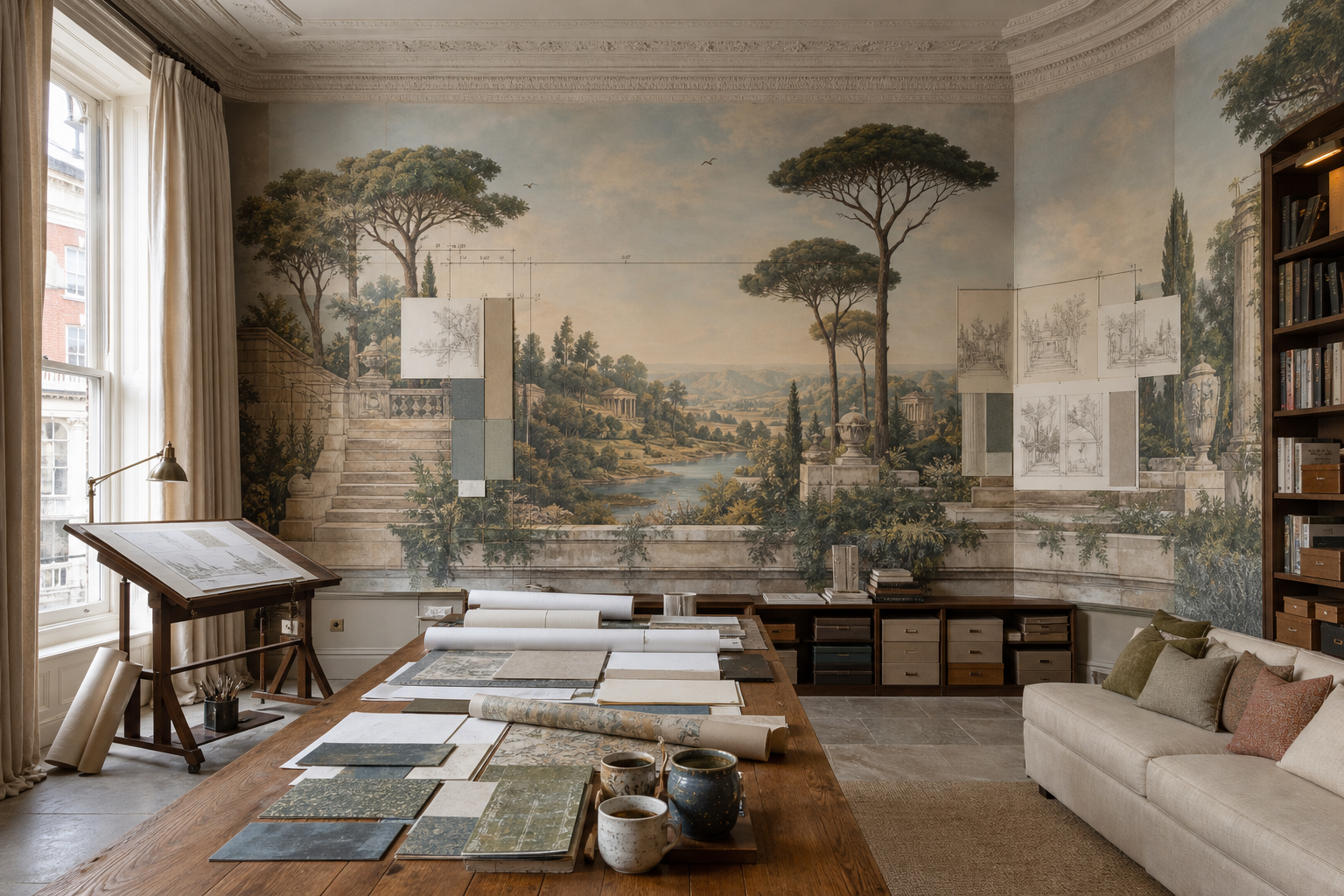
The elevation is therefore not administrative paperwork. It is the moral document of the mural. Every opening, object and fixed element should be drawn before the composition is approved. The horizon should be placed, not hoped for. A tree trunk should know whether it is allowed to meet the edge of a bookcase. A figure, if there is one, should not spend the rest of its life decapitated by a picture light. A distant river should not vanish behind the back of a sofa.
This is why our earlier essay on luxury panoramic wallpaper as architecture matters so much to bespoke work. The mural is not a large picture. It is a spatial instrument. Its scale must be judged from the threshold, the principal seat, the standing view, the evening lamp view and the unflattering moment when the room is half-installed and no one can pretend the socket is not there.
The Wall Is a Material Condition
As a conservator, I am obliged to spoil the fantasy at regular intervals. The wall is not an abstract plane. It is plaster, plasterboard, paint, previous adhesive, filler, salts, moisture, dust, primer, temperature, movement and occasionally a hidden history of repairs performed by someone with more confidence than skill. A bespoke mural printed or painted for the wrong wall is not a treasure. It is a hostage.
The Wallcovering Installers Association’s guidance on wallcovering preparation is pleasingly unsentimental: defects must be repaired, surfaces cleaned, stains and mildew treated, and walls primed appropriately for wallcovering. It also urges following manufacturer instructions. This may sound obvious. In luxury work, obvious things are often the first casualties of speed.
For high-value murals, I would add a few questions before anyone celebrates. Has the wall been moisture-tested where appropriate? Is the substrate dimensionally stable? Are old adhesives removed? Will the chosen ground tolerate the room’s humidity, cleaning regime and light exposure? Is the adhesive compatible with the paper, silk, vinyl, grasscloth or specialist finish? The wall decides more than the mood board admits.
Samples Should Be Interrogated, Not Admired
A sample is not a souvenir. It is evidence. It should be looked at vertically, at scale, in the actual room, under daylight and evening light, beside the timber, stone, curtain lining, upholstery, metal finish and paint that will have to live with it. If the sample is too small to reveal repeat, grain, ground colour, sheen or print density, ask for more. Luxury is not guessing expensively.
The WELL Standard’s VOC Reduction feature is a useful reminder that interior paints, coatings, adhesives and sealants can affect indoor air quality. Designers do not need to turn every mural conversation into a building-science lecture, but they should request clear product information when the project, client, jurisdiction or certification framework requires it.
Light is the other examiner. Matte scenic paper may become wonderfully deep under lamplight. Silk may become ravishing or too theatrical. Metallic grounds may give a dining room life and a bedroom insomnia. A cool LED can flatten a painted garden into printed décor. Warm lamps can rescue a grisaille from austerity. Samples must be made to answer these questions before the room is committed.
Installation Is Part of the Design
Installation is not the practical end of the design. It is the moment when the design becomes true or false. The installer should be brought in early enough to comment on substrate, seams, wall condition, sequence, access, ceiling height, stair turns, lift dimensions, protection, humidity, drying time and the tolerances around corners and openings.
With bespoke murals, seam placement is composition. A join through a tree trunk may be tolerable; a join through a face, a bird, a temple column or a line of horizon may not be. A corner can be a place of grace or a place where perspective falls apart. A door return can become a secret continuation of the scene, provided someone has measured it before everyone is standing there with paste and panic.
This is also the point at which romance meets programme. Handmade panels, custom colourways, revised artwork, strike-offs, specialist grounds and international shipping do not care that the reveal party is on Thursday. A serious specification builds in time for review, correction, acclimatisation and installation conditions. Beautiful walls rarely enjoy being rushed.
The Handover Should Outlive the Photograph
The Getty Conservation Institute describes preventive conservation as the study of environmental factors such as light, pollutants, temperature, humidity, shock and vibration, and how improvements can help mitigate future damage. That museum language applies, in quieter form, to luxury interiors. A wall mural is not a museum object, but it is still a material object living under light, touched by air, affected by cleaning and vulnerable to use.
The handover should therefore include more than congratulations. Keep approved elevations, final artwork files where contractually permitted, production references, batch numbers, leftover material, adhesive notes, installer details, care instructions, photographs of the completed room and any agreed cleaning limitations. Record what was installed, not merely what was imagined.
This is especially important in houses that will evolve. A future sconce, a new headboard, a replacement sofa, a repaired leak or an enthusiastic repainting of trim can undo the intelligence of the original composition. The best bespoke mural is not frozen, but it should be documented well enough that future changes do not vandalise it by accident.
Which Mural Language Deserves Bespoke Treatment?
Different mural traditions deserve bespoke treatment for different reasons. Zuber remains the stern and magnificent reminder that scenic wallpaper can be architecture, craft and sequence. De Gournay is persuasive when a client wants the human hand, luminous grounds and a couture level of botanical or chinoiserie adjustment. Ananbo belongs when the brief asks for dreamlike landscape, Mediterranean memory or tropical distance with a distinctly French scenic soul.
Iksel can be powerful when the room needs encyclopedic architecture, tented illusion or ceiling logic. Pierre Frey is valuable when the mural must converse with fabric, upholstery and an archive-minded scheme. Nobilis and Elitis can bring tactility and restraint when the luxury lies less in pictorial drama than in surface intelligence. Designers Guild may be right when joy is not an embarrassment, though it requires a room capable of holding colour without becoming frantic.
The house, however, is not the solution by itself. Bespoke does not mean asking a famous name to rescue an unresolved room. It means giving the right atelier a properly drawn problem: the architecture, the client, the light, the budget, the programme, the maintenance reality and the emotional temperature the room must hold.
A Specifier's Checklist for Bespoke Wall Murals
A practical checklist, then. First, write the mural brief in verbs: extend, shelter, frame, quieten, brighten, dignify, conceal, transport, soften, structure. Second, draw every elevation with furniture, lighting, doors, windows, services, switches, sockets, cabinetry, curtain stacks and skirting. Third, place the horizon and principal motifs before approving the artwork.
Fourth, inspect the wall as a substrate, not as a hope. Repair, clean, prime and test as the product and installer require. Fifth, review samples vertically in the actual light, with the real adjacent materials. Sixth, decide seam logic, corner logic, panel sequence and whether the mural continues over doors, within moulding, above a dado or to the floor.
Seventh, confirm adhesive, emissions documentation, cleaning limits, programme and installer responsibilities. Eighth, protect the lower wall where life demands it. Ninth, archive the record: artwork, elevations, samples, product data, batch details, spare material and maintenance notes. Tenth, sit in the room at the end and ask the only question that matters: has the mural improved the architecture, or merely made it more expensive?
The Room Must Still Be the Room
The seduction of bespoke wall murals is that they appear to offer escape from compromise. In truth, they require a more intelligent form of compromise: between image and architecture, atmosphere and maintenance, dream and measurement, artistry and the ordinary life of a wall. That is not a limitation. It is the condition that makes the result worthy of a serious room.
A fine bespoke mural should not make the interior feel bullied by its own uniqueness. It should make the room feel more itself: deeper, stranger, calmer, more memorable, more precise. The client may notice the landscape first, then the colour, then the hand, then the way a lamp warms a painted cloud, then the strange pleasure of a corner that has been considered.
That is when bespoke has done its work. Not when the wall announces that it is custom, but when the room seems impossible without it. The mural has taken its risk, and the room has survived beautifully.