The Accent Wall Is Too Timid: Luxury Panoramic Wallpaper as Architecture
By Seraphina Bellweather · Published August 17, 2026
The Accent Wall Has Become a Nervous Gesture
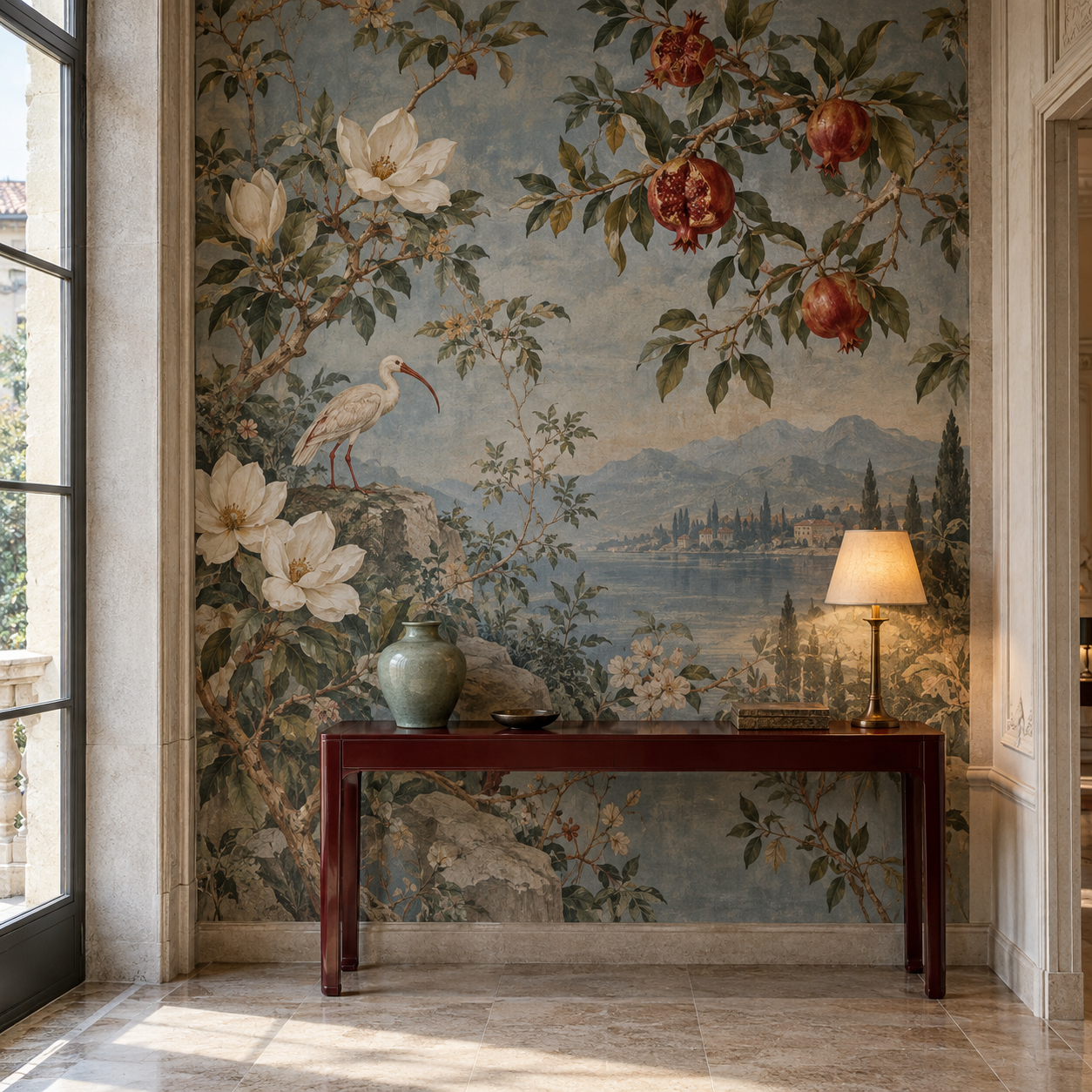
There is a species of wall treatment that always makes me a little uneasy: the single decorative wall, isolated behind a sofa or bed, performing bravery while the rest of the room retreats into plain paint. It is not that an accent wall is automatically vulgar. Some are perfectly judged. But too often it reads as a nervous compromise, the decorative equivalent of dipping one gloved finger into cold water and declaring one has swum.
Luxury panoramic wallpaper asks for a more serious imagination. It belongs to the lineage of rooms, not posters. It was conceived to change how architecture is read: to extend distance, soften boundaries, correct proportion, create atmosphere and make a room feel as though it has acquired a view, a memory, perhaps even a climate. When confined to one apologetic wall, much of that intelligence is lost.
The current dislike of timid feature walls is therefore not merely a trend complaint. It is a useful correction. Designers are beginning to say aloud what historic scenic papers have always known: if the wallcovering is strong enough to carry a world, it should be allowed to build one.
Panoramic Wallpaper Was Never Meant to Behave Like a Poster
The museum record is clarifying here. The Musee du Papier Peint describes panoramic scenic wallpapers as landscapes pasted sheet by sheet so the person in the room feels surrounded and imaginatively transported to another time or place. That word surrounded is not decorative embroidery. It is the operating principle.
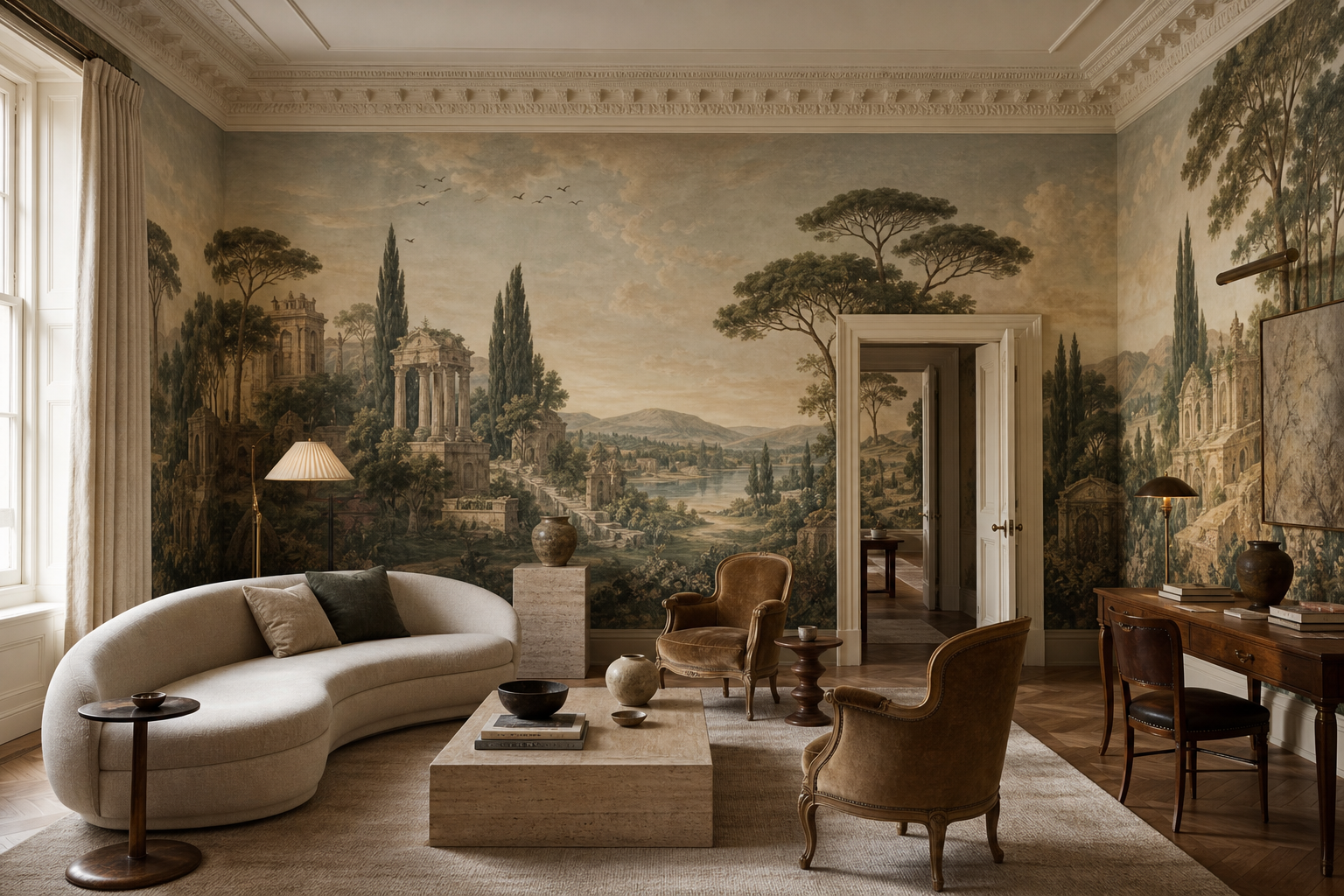
A panorama was not designed as a large picture. It was a spatial instrument. Its sheets were engineered to move around corners, negotiate doors, pass behind furniture, and keep an imagined landscape continuous enough for the room to surrender its ordinary boundaries. The best luxury panoramic wallpaper still works this way, even when digitally printed, hand-painted, silk-backed or adapted to contemporary dimensions.
One can certainly place a scenic panel within moulding, just as one might hang a tapestry or mount a folding screen. But that is a different proposition. The full panoramic room is closer to architecture. It changes the behavior of the walls themselves.
Why the 2026 Wallpaper Conversation Matters
The timing is interesting. Livingetc’s 2026 discussion of outdated wallpaper styles places accent walls first among the applications designers are moving beyond, favoring more integrated uses of paper, texture and depth. It also distinguishes cheap photographic scenery from wraparound murals with genuine storytelling. That distinction matters enormously. The failure is not the scene. The failure is the unconvincing scene, used without architecture, craft or intention.
House Beautiful’s 2026 wallpaper trend report makes a related point from the positive side, noting the rise of transportive scenes and floor-to-ceiling wallpaper applications that shape the feeling of a room rather than merely decorate it. ELLE Decor’s wallpaper trends coverage adds the vocabulary of atmosphere, emotion, tactile surfaces and hand-painted character.
None of this is an argument for recklessness. It is an argument for seriousness. If a client is commissioning a mural that claims depth, craft and transport, then the specification should respect the claim. A timid installation can make even a magnificent paper look like a sample that escaped the library.
Corners Are Not a Problem. They Are the Point.
Corners reveal whether a panoramic wall has been properly understood. A weak accent wall avoids them. A true panoramic room uses them. The corner is where the fictive landscape must turn without becoming absurd. A tree may become a hinge, a ruin may recede, a cloud bank may soften the transition, a river may pull the eye diagonally from one wall to the next. These are not minor placement decisions. They are composition.
The same is true of doors, windows, fireplaces, radiators, bookcases and drapery stacks. They are not interruptions to be regretted after installation. They are the architecture the mural must answer. A door reveal can become a delicious glimpse into a continuing landscape. A window can be framed by painted foliage so the real exterior and imagined exterior enter into polite conversation. A fireplace can sit before a ruin or grove with a dignity no small framed print could provide.
This is why our essays on neutral interiors and living room murals return so often to the horizon. The horizon must be placed, not merely admired. Its height, rhythm and survival across corners decide whether the room feels expanded or merely covered.
The Material Intelligence of Immersion
As a conservator, I am suspicious of any decorative decision that treats surface as only image. Fine wallcoverings are also matter: paper, silk, grasscloth, ground, pigment, ink, glaze, varnish, adhesive, seam, substrate, light exposure and eventual repair. A panoramic room amplifies every one of these realities. Full immersion is ravishing, but it is not casual.
The SFO Museum’s exhibition note on Zuber and French scenic wallpaper reminds us that 19th-century scenic landscape papers created panoramic experiences with all walls covered by non-repeating scenes. It also points to the extraordinary labor behind the tradition. This is useful not as nostalgia, but as discipline. The most convincing contemporary panoramic rooms still depend on exacting measurement, sequence, alignment and respect for the wall as an installed object.
Material choice changes the mood. A matte paper can make a grand panorama feel breathable and scholarly. A silk ground can bring luminosity, but may become too assertive under hard light. A fibrous ground can soften acoustics and help the mural sit among upholstery. A high-contrast print may photograph handsomely and live badly. The sample must be read not in the hand alone, but vertically, at scale, in the actual light, near the actual chair, timber, curtain lining and lamp.
Which Rooms Deserve the Full Panorama?
Not every room needs to be wrapped. This is where fashion often becomes imprecise. A full panoramic treatment is strongest when the room has a reason to become immersive: a drawing room that lacks a view, a dining room that wants ceremony, a library that needs depth, a hallway that deserves procession, a bedroom that can accept quiet landscape, a powder room that can become a small intellectual jewel.
One should be more cautious in rooms already crowded with art, complicated cabinetry, heavy stone veining, open kitchens full of appliances, or architecture too assertive to share command. A panoramic paper can still work, but perhaps as panels, as a framed scenic sequence, as a single wall with a return, or as a mural paired with quieter textured grounds. The point is not to paper everything. The point is to stop treating the accent wall as the only available form of courage.
The ceiling, too, must be considered with care. We have already praised the fifth wall, but a ceiling continuation should not be automatic. Sometimes the ceiling completes the envelope. Sometimes it ruins the necessary pause. The best rooms know when to surround and when to let plaster breathe.
Which Houses Understand the Architectural Wall?
Zuber remains the great historical reference because its panoramics demonstrate wallcovering as architecture, craft and cultural document at once. De Gournay brings the human hand and luminous bespoke possibility. Ananbo is persuasive when a room needs landscape as memory, particularly a romantic distance rather than a literal place. Iksel understands the mural as an encyclopedic, architectural field, often especially powerful in ceiling and full-room applications.
Pierre Frey is valuable where textile intelligence matters, because upholstery, curtain, trim and mural must not behave like strangers. Nobilis and Elitis can bring tactility and Parisian restraint when full pictorial narrative would be too much. Designers Guild, used judiciously, can make a room more joyful, though one must watch the point at which exuberance begins to flatten depth.
The house is never a substitute for the elevation. Even the most beautiful luxury panoramic wallpaper can fail if scaled badly. Conversely, a quieter mural can become extraordinary when the architecture, furniture and light are composed around it. The specifier’s authority lies in that translation from sample to room.
A Specifier's Checklist for Full-Room Panoramics
A practical checklist, then. First, decide whether the mural is to wrap the room, occupy two walls, sit within panels, or act as one principal scenic wall with meaningful returns. Second, draw every elevation before approving scale: doors, windows, curtains, fireplace, switches, outlets, sconces, bookcases, radiators, furniture backs, picture lights and art.
Third, place the horizon deliberately. Too high, and the room becomes top-heavy. Too low, and furniture may decapitate the view. Fourth, use corners as compositional events, not leftovers. Fifth, request a layout proof that shows how the design meets each opening and obstruction. Sixth, inspect samples in morning light, afternoon light and evening lamp light, beside the real fabrics and finishes.
Seventh, plan durability. Lower walls meet chairs, children, dogs, handbags, vacuum heads and hands. A dado, painted base or wainscot may be more elegant than pretending life will not touch the paper. Eighth, order and archive spare material, record production details, photograph installed walls, and keep the approved elevations. Luxury is not only the first unveiling. It is the capacity to conserve the effect.
Let the Room Commit
The accent wall will not disappear, nor should it. There are rooms where a single wall is exactly right. But as the default answer to a luxury scenic brief, it is often too timid, too abrupt, too uninterested in architecture. It gives us the image without the environment.
The great panoramic tradition offers something better: commitment with intelligence. A room in which walls are no longer flat recipients of decoration, but active participants in proportion, light, depth and memory. A room where a corner matters. A room where the view is invented, but the craft is real.
So let the room commit. Let the mural turn the corner, answer the door, lower the horizon, spare the lamp, meet the curtain, and make the furniture feel placed before a world. That is the difference between wallpaper as purchase and wallpaper as architecture. It is also the difference, my friends, between a wall that has been decorated and a room that has begun to think.