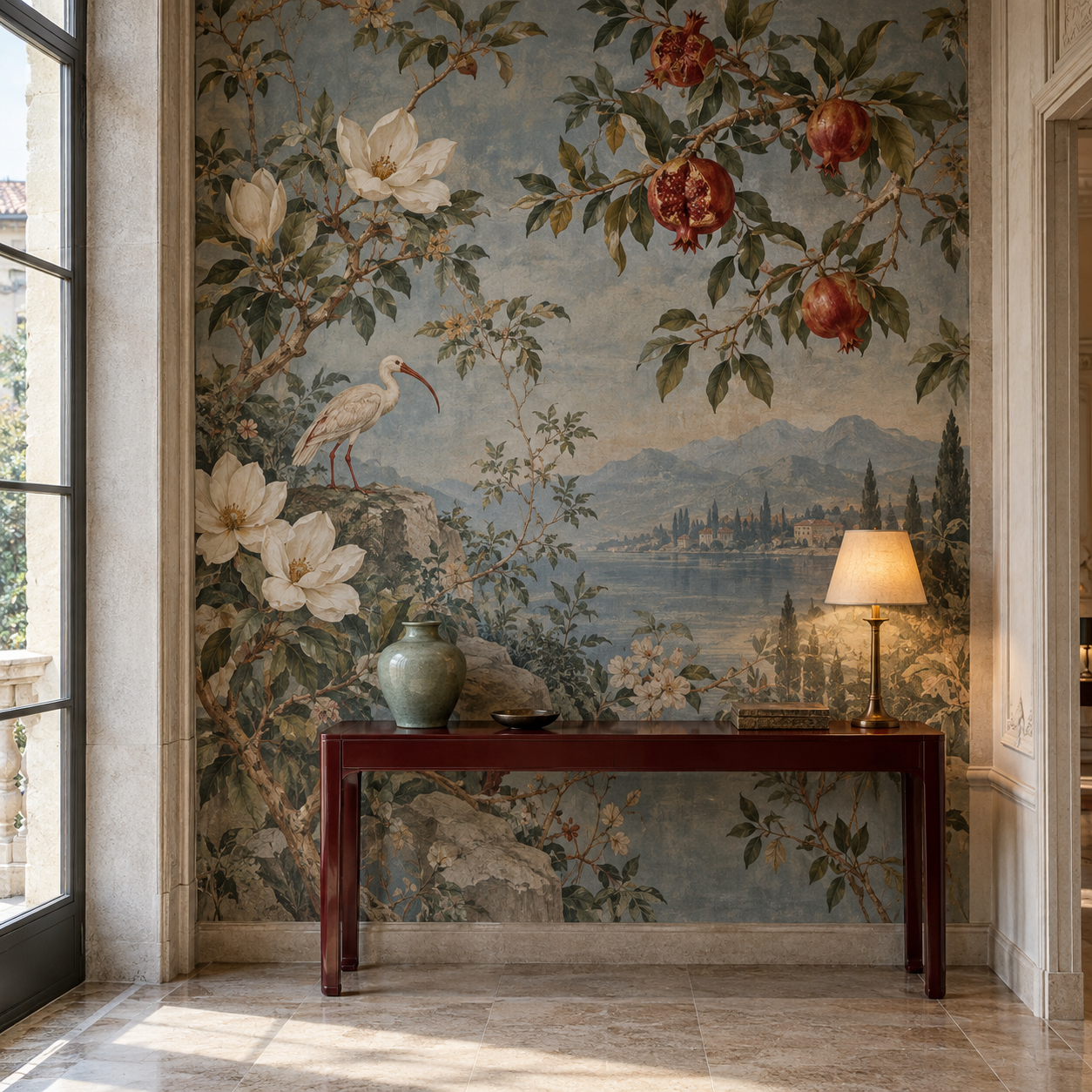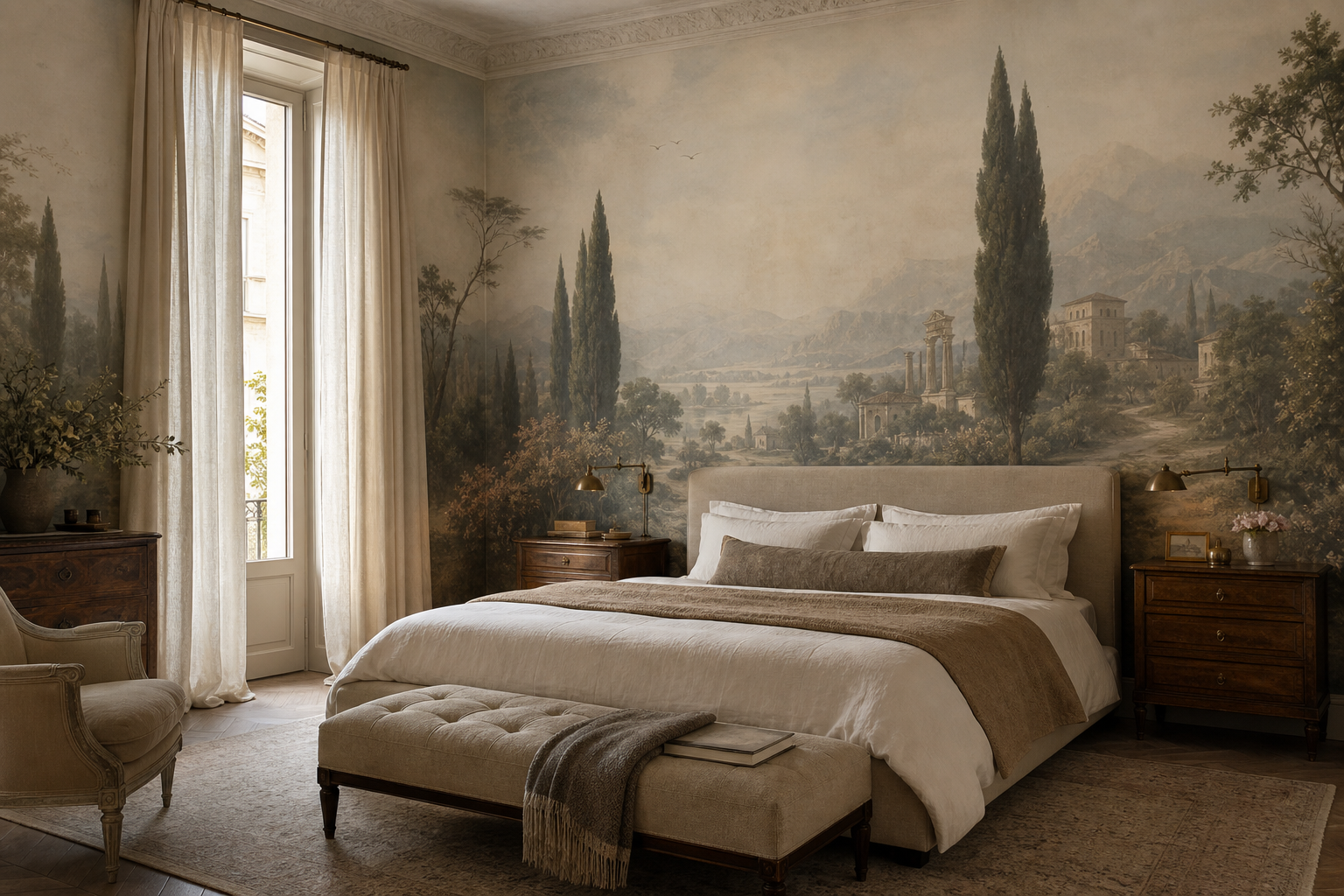
The Sleeping Landscape: Luxury Wall Murals for Bedrooms
By Geneviève Ashworth · Published July 28, 2026
A Bedroom Is a Private Weather
My dears, a bedroom is not simply the room in which a bed has been placed. At its best, it is a private weather system: softer air, lower voices, gentler light, a place where the day loosens its grip. This is why luxury wall murals for bedrooms require such delicacy. A mural may transport, yes, but in the sleeping room it must never abduct. It must lead the mind elsewhere without making the body feel watched, crowded or theatrically on display.
We have already considered dining rooms, studies, staircases and powder rooms, each with its own kind of drama. The bedroom asks for another art altogether. It is the art of the lowered curtain, the far horizon, the branch seen through morning haze. A scenic wall can give the room depth, but that depth must be restful enough to live with at midnight and merciful enough to greet at six in the morning.
That is the quiet opportunity. A bedroom mural can make a primary suite feel composed rather than furnished. It can turn a headboard wall into a dawn landscape, a canopy of trees, a faded garden, a misted coast. It can give the client the luxury of waking somewhere beautiful before the first email, the first decision, the first little demands of ordinary life.
Begin With Sleep, Not the Headboard Wall
The first mistake is to begin with the headboard wall as if it were a stage awaiting scenery. Mais non. Begin with sleep. Begin with darkness, temperature, sound, the route to the bathroom, the lamp one switches off with a tired hand, the window that leaks too much city light, the chair that gathers a robe, the dog who insists on choosing the rug. The mural must join this life, not merely decorate its photograph.
ELLE Decor’s 2026 report on bedroom design describes a move toward more personal, soulful rooms: color-drenched atmospheres, cocoon-like texture and increasingly analog bedrooms where technology retreats. That is precisely the territory in which a mural can be useful. It can give the room identity without requiring noise. It can replace the blank wall behind a television with something infinitely more civilised: distance, trees, clouds, architecture, memory.
For designers, the question is not whether the mural is beautiful in isolation. It is whether the room becomes easier to inhabit. Does the eye rest? Does the palette quiet the nervous system rather than flatter a sample board? Does the scene hold enough silence for a person who is no longer performing for the day?
The Landscape That Lowers Its Voice
Bedrooms are especially sensitive to narrative. A dining room can accept birds in conversation with guests. An entrance hall can enjoy a little procession, a little arrival, even a touch of grand folly. But a bedroom should be cautious with figures, busy animals, theatrical ruins and high-contrast incident. A sleeping person does not need an audience. The most successful luxury wall murals for bedrooms tend to offer landscape without intrusion: a grove, a low hill, a pale lake, a quiet terrace, a garden path just before anyone has walked upon it.
Depth is more useful than drama. A low horizon behind the bed can make a compact room breathe. A softened grisaille landscape can give a city bedroom the calm of distance. A dawn garden can be romantic without becoming sugary. The composition should feel as though it has exhaled. If the eye keeps finding a new argument in the pattern, the mural belongs elsewhere.
This is where our earlier piece on luxury wall murals for home offices becomes an unexpected cousin. The study needs concentration; the bedroom needs release. Both rooms benefit from a horizon that gives the eye somewhere humane to go.
Color, Texture and the Cocoon
Current wallpaper conversation is helpful here because it has moved beyond the simple question of pattern. ELLE Decor’s 2026 wallpaper trend coverage points to wallcoverings with atmosphere, tactile character, hand-painted feeling and sophisticated color. In a bedroom, these qualities matter more than novelty. The surface should seem touched, softened, almost breathed into being.
Texture is particularly important. A matte scenic paper, a subtly fibrous ground, a hand-painted silk used with restraint, a linen-like wallcovering with pictorial depth: these can make the room feel acoustic as well as visual. The bedroom is one of the few rooms where softness is not indulgence but function. Upholstery, curtains, rugs, bedding and wallcovering should work together to absorb the sharpness of the day.
Color must be chosen as a climate. Smoky olive, faded blue, warm stone, parchment, tea, lichen, dove, mineral grey, old rose in the smallest dose: these are bedroom colors not because they are fashionable, but because they know how to recede. Deep color can be exquisite, especially when it wraps walls, trim and ceiling into one calm envelope. But beware of the theatrical dark that looks divine in an evening photograph and heavy every winter morning.
Light: The Most Ruthless Critic
Light is the bedroom mural’s most ruthless critic. A scenic paper that glows enchantingly at noon may become too active under bedside lamps. Metallic grounds can turn a quiet landscape into a restless shimmer. Pale grounds can glare against pillows. Dark grounds can swallow the room when shutters close. The sample must be judged beside the actual linen, timber, metal and lamp, and judged again after sunset.
This is not merely aesthetic fussiness. The Sleep Foundation’s current guidance on light and sleep explains that light is one of the strongest regulators of the body’s internal clock, while evening and nighttime light can interfere with sleep. Designers do not need to become sleep scientists to respect that fact. They simply need to remember that the bedroom is not a showroom for illumination. It is a room in which darkness has a job to do.
The WELL Standard’s Light at Night feature makes the practical point even more sharply, calling for sleeping areas to control window light, eliminate unwanted electronics glow and use very low, carefully placed navigation lighting where needed. Translate that into mural language and the lesson is clear: specify blackout properly, hide glowing devices, keep bedside lighting warm and low, and avoid mural finishes that turn every small lamp into visual static.
Where the Bed Meets the Panorama
The headboard is not an obstacle to the mural. It is part of the composition. Too often, a beautiful scenic is chosen, then half of its central idea disappears behind upholstery. A temple loses its base. A bird hovers awkwardly above a pillow. A tree trunk divides the bed like a theatrical warning. Draw the bed, headboard, bedside tables, lamps, switches, sockets, picture lights and curtain stack on the elevation before approving the mural scale.
Low headboards are often kinder to a panorama because they allow the horizon to breathe. Tall upholstered headboards can be magnificent when the mural becomes a kind of landscape frieze above them, but the meeting line must be deliberate. If the bed is canopied, the mural should either recede behind the structure or join its romance without overcrowding it. If there are bedside sconces, give them quiet passages of sky, foliage or stone, not the most delicate moment in the scene.
Think also of the first view from the bed. A mural is not only seen on arrival. It is seen from the pillow, from the chair, in the mirror, half-lit by a reading lamp, perhaps reflected in a dark window at night. The bedroom mural must pass all these tests because it will be encountered when the client is least armored.
Which Mural Language Belongs to Rest?
Ananbô is especially persuasive in bedrooms when the brief asks for landscape as dream rather than declaration. Its romantic sense of distance, Mediterranean memory and painterly travel belongs naturally to rooms where the mind should wander gently before sleep. Zuber brings historical gravity and magnificent craftsmanship, though its grander panoramas need careful quieting in a sleeping room. De Gournay can make a bedroom feel like a hand-painted garden chamber, especially when birds and blossom are scaled with restraint.
Nobilis may be right where the room asks for Parisian tact and layered texture rather than overt story. Pierre Frey can bring archival charm or a textile intelligence that speaks beautifully with upholstery. Elitis is useful when touch and surface matter more than pictorial narrative. Designers Guild, used with discipline, can make a guest bedroom joyful without making it restless.
The choice should follow temperament. A coastal bedroom may want pale distance. A city primary suite may need a garden it cannot otherwise have. A country bedroom may prefer a mural that feels inherited, faded by generations of mornings. A guest bedroom can accept a slightly brighter note, provided it still allows the guest to sleep rather than admire bravely until dawn.
A Specifier's Checklist for the Sleeping Room
A practical checklist, then. First, place the bed and lamps before placing the mural’s focal point. Second, decide whether the room wants a single horizon, a wrapped landscape, a panelled scenic or a quieter mural confined by moulding. Third, test the ground under morning light, evening light and the actual bedside lamps. Fourth, confirm blackout treatment before falling in love with a pale paper that will be ruined by streetlight.
Fifth, protect vulnerable zones. Behind a bed, abrasion is real. Around switches, hands are real. Near curtains, dust and movement are real. Keep spare panels, record production details, photograph the approved elevation and note the exact paint and fabric references beside which the mural was chosen. Luxury is not only the dream; it is the ability to maintain the dream without panic.
Sixth, consider the room’s silence. A mural can be too loud without using bright color. Dense detail, sharp contrast, too many birds, too much architecture, a horizon placed too high, a tree trunk too close to the sleeping head: all can create unease. In a bedroom, editing is a form of kindness.
The Room That Lets the Day Leave
The finest bedroom murals do not ask to be congratulated. They let the day leave. They make sleep feel prepared for, almost hosted. They give morning a gentler threshold and night a more gracious enclosure.
This is why I return, again and again, to landscape for the sleeping room. Not because other mural languages cannot work, but because landscape understands distance. It can hold memory without demanding explanation. It can make a wall feel porous, as if the room has borrowed a little mist, a little garden, a little ancient light from elsewhere.
Choose slowly. Sit on the bed with the sample in the actual light. Switch off the overheads. Let the lamp warm. Close the curtain. Look again in the morning before the room has tidied itself into politeness. If the mural still feels calm, still gives depth, still leaves the mind quieter than it found it, then it belongs. A bedroom is the most private theatre in the house, my dears. Its scenery should know when to whisper.