The Suite They Remember: Luxury Wall Murals for Boutique Hotels
By Noora Al Hashemi · Published July 15, 2026
A Room Is Remembered Before It Is Reviewed
In the highest tier of hospitality, a suite is no longer judged only by thread count, marble thickness or the generosity of the dressing room. Those things matter, of course. They are part of the contract. But they are not usually what a guest remembers six months later, when another city, another check-in and another polished corridor have blurred together. What remains is atmosphere. A particular hush at dusk. A view one did not expect. A room that seemed to know how one wished to feel before one had quite articulated it.
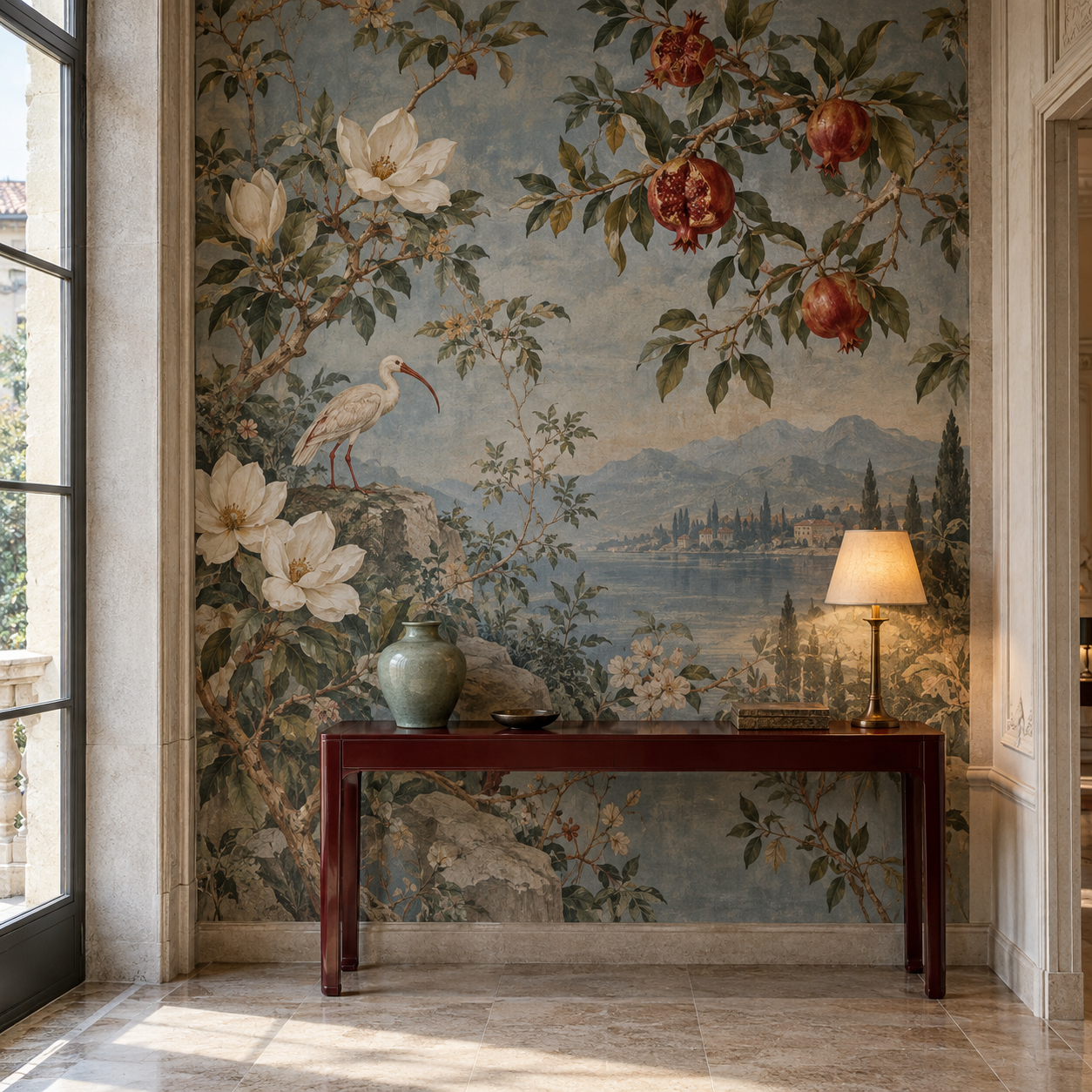
This is precisely where luxury wall murals for boutique hotels become so potent. They do not behave like decorative accessories. They establish the emotional geography of a stay. A panoramic mural can give a windowless private dining room a horizon, turn a spa corridor into a slow exhale, or make a suite feel connected to a landscape even when the actual view is a neighboring facade. Used with intelligence, it becomes the hotel’s most discreet form of storytelling.
I say discreet deliberately. Hospitality design is full of loud gestures that photograph well and exhaust quickly. A truly successful mural does something more sophisticated: it gives the guest a world to inhabit, then allows that world to recede into comfort. The wall is memorable, yes, but never needy. It supports sleep, conversation, arrival and return. That balance is the great luxury.
Begin With the Guest’s First Ten Seconds
Designers often speak of arrival as though it belongs only to the lobby. In reality, every room has its own arrival sequence. The key card turns, the door opens, the guest steps in with luggage, fatigue, curiosity and, perhaps, a very high expectation of being gently impressed. The first ten seconds decide whether the suite feels generic or inevitable.
A mural placed opposite the entrance can act as the room’s immediate ambassador, much as we discussed in murals that announce arrival. But a hotel suite asks for a softer form of proclamation. The guest is entering a private refuge, not a public salon. A mural behind the bed may reveal itself after the first step into the room. One wrapping a sitting area may be discovered only once the luggage is down and the curtains are drawn. That delay can be exquisite.
The question is not simply where the largest blank wall sits. It is where the guest will pause. Will the mural be seen from the bed in the morning? From the bath through an open doorway? Reflected in a bronze-framed mirror? Framed by curtains at blue hour? Hospitality is choreographed repetition; hundreds of guests will move through the same sequence. The mural must reward that sequence without overwhelming it.
Choose a World, Not a Pattern
A boutique hotel mural should begin with a world, not a pattern. This is the distinction that separates atmosphere from surface treatment. A pattern can be charming, even beautiful, but a world carries memory. It has light, depth, climate and implication. It suggests that the hotel knows where it is, or where it wishes to transport its guests.
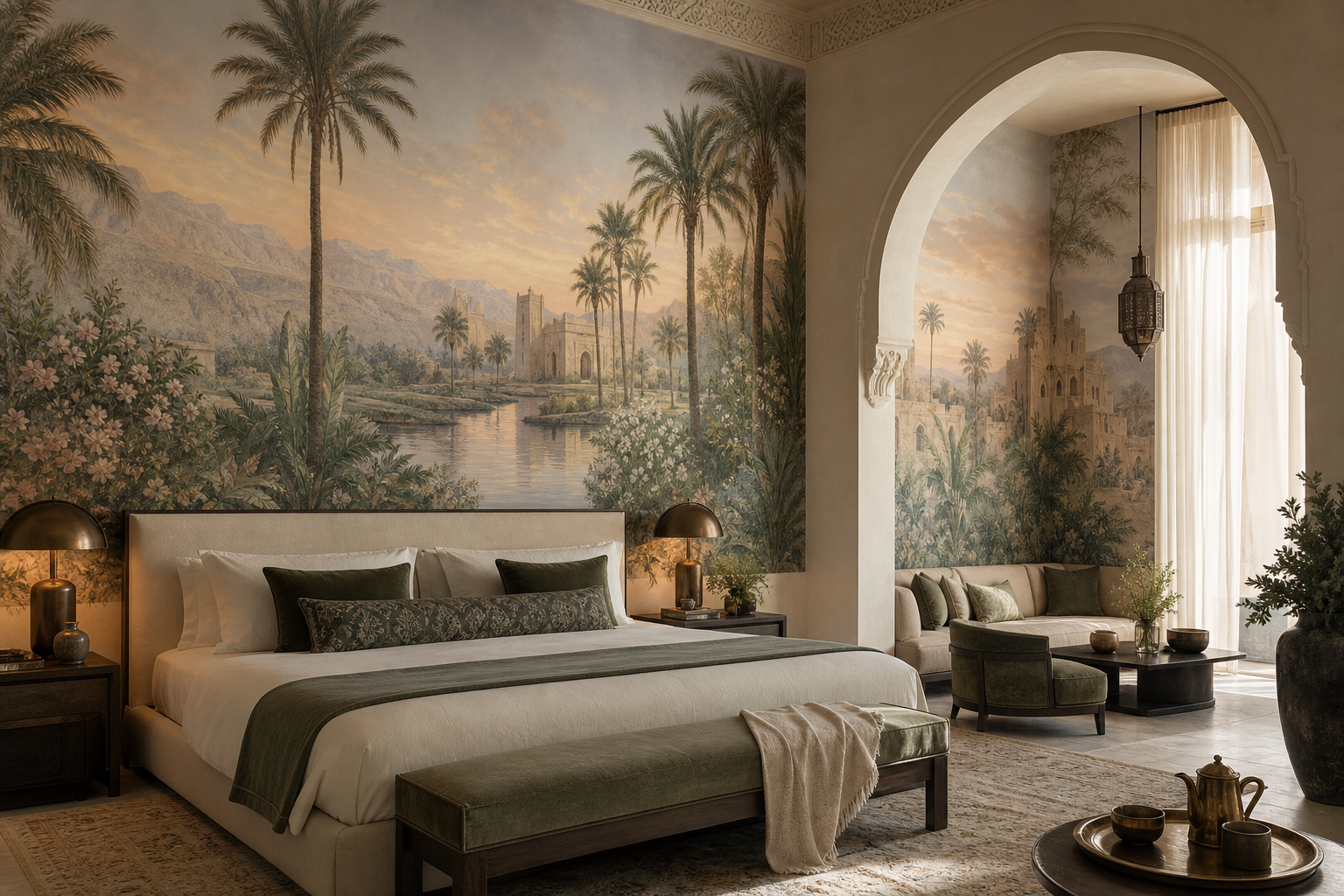
For an urban hotel, the mural might offer a dream of landscape rather than a literal map of the city: a misted garden, a riverbank, a grove, an architectural capriccio softened by distance. For a resort, the wiser choice may be restraint. If the true sea lies outside the window, do not paste a competing sea behind the bed. Choose instead the inland story: palms at dawn, ancient stone, a garden wall, a botanical fragment that deepens the sense of place without duplicating the view.
The great houses offer different languages for this work. De Gournay brings that extraordinary hand-painted narrative potential, especially when a hotel wants the aura of rarity and bespoke patronage. Zuber offers historical breadth and scenic authority, ideal when heritage is part of the brief. Ananbo’s painterly panoramas can lend a romantic, transported quality to suites that need emotional softness. Elitis, Nobilis and Pierre Frey may be more suitable when texture, abstraction or Parisian restraint must carry the atmosphere. Designers Guild, used carefully, can give a hospitality space a more vivid, contemporary optimism.
The right choice is not the most famous name. It is the visual language that lets the room keep its promise.
The Quiet Power of Biophilic Murals
There is also a more contemporary reason murals feel so relevant to hospitality now: they can offer a sophisticated form of biophilia without reducing nature to a pot plant in the corner. The most persuasive nature-led interiors are not merely green. They contain complexity, variation, filtered light, refuge, prospect and moments of awe.
The design conversation around this is increasingly rigorous. Terrapin Bright Green’s 14+ Patterns of Biophilic Design, revised in 2026, frames biophilic design around relationships between nature, human biology and the built environment, including the newer pattern of awe. The WELL Standard’s Biophilia I feature similarly asks projects to consider nature incorporation, natural patterns and opportunities for interaction. A mural is not a substitute for daylight, air or a garden, naturellement. But it can be an emotionally powerful part of this larger design ecology.
In a hotel, this matters because guests are often in transition. They arrive from airports, meetings, celebrations, grief, exhaustion, romance. A mural that offers layered natural imagery – water, foliage, horizon, birds, clouds, stone, shadow – can lower the emotional temperature of a room. It gives the eye somewhere generous to rest. It creates the feeling of being held by a place rather than processed through a property.
Where the Mural Should Speak Most Clearly
Not every hotel wall deserves a mural. This is where taste proves itself. A mural should speak where the experience needs memory, not where the budget needs filling.
Suites are the most obvious candidates because guests spend enough time there for the scene to become part of the stay. Behind the bed, the mural must be serene enough to sleep beside; in the sitting area, it may carry more narrative and colour. Private dining rooms are another natural home. They need atmosphere immediately and often lack the architectural drama of the main restaurant. A scenic wall can create intimacy around the table, particularly when candlelight catches a matte ground or metallic detail.
Spa lounges and treatment corridors require a different discipline. Here, the mural must calm the nervous system rather than perform. Pale botanical grisaille, distant landscapes, water and softened architectural forms are often more persuasive than dense jungle drama. In a bar or members’ lounge, however, the mood may become more theatrical: a nocturne, a garden at night, a lacquered chinoiserie, a mural that feels like a confidence shared after midnight.
Ceilings deserve consideration too, especially in suites where the bed is the primary viewpoint. Our thoughts on the decorated fifth wall apply beautifully to hospitality, provided the ceiling treatment is tender rather than restless. Guests should not wake beneath visual noise.
Craft, Maintenance and the Realities of Hospitality
Hospitality is romance under operational pressure. A mural may be poetic, but it must survive luggage, housekeeping, climate control, maintenance teams, fragrance systems and the occasional guest who treats a five-star suite as if it were indestructible. The practical conversation is not a betrayal of beauty. It is what protects it.
Begin with durability appropriate to the room. A hand-painted silk may be magnificent in a private salon suite but unwise in a narrow luggage corridor. A high-quality non-woven scenic paper, properly sealed where needed, may be more suitable for higher-traffic zones. Textured or embroidered surfaces can add extraordinary depth, and current luxury design is clearly moving toward more tactile walls; AD PRO’s 2026 interior forecast notes the appetite for dimensional, crafted wall treatments. But tactile richness must be specified with cleaning, repair and replacement in mind.
Panel planning is critical. In hotels, damage rarely occurs in the poetic middle distance; it occurs at corners, around switches, behind chairs and near housekeeping routes. A custom mural should anticipate this. Place irreplaceable focal motifs away from impact zones. Keep extra panels. Record colour references. Confirm fire ratings, substrate preparation, humidity tolerances and cleaning protocols. Make the installer part of the design team early, as one would for stone, lighting or acoustic work.
Luxury is not fragile. Luxury is maintained beauty.
The Mural as the Hotel’s Private Signature
The most successful boutique hotels have a signature that cannot be reduced to a logo. One recognizes them by an atmosphere: the kind of quiet in the corridor, the proportion of the lampshade, the scent after rain, the way the bar becomes golden at seven o’clock. A mural can become part of that private signature if it is treated as a design instrument rather than a decorative flourish.
Imagine a small desert hotel whose suites each hold a different hour of an imagined oasis: dawn in one, late afternoon in another, a moonlit garden in the most private room. Imagine a townhouse hotel where each landing carries a fragment of a painted park, so the guest ascends through leaves before reaching a bedroom of calm plaster and linen. Imagine a city spa where a pale panoramic river runs quietly along the relaxation lounge, not as spectacle, but as a visual breath between treatments.
This is the true opportunity. A mural allows hospitality design to create memory without shouting for attention. It gives a hotel a world, and gives the guest the rare pleasure of feeling briefly inside it. For designers, that is the difference between a room that is admired and a room that is returned to. The first may win a photograph. The second wins loyalty.