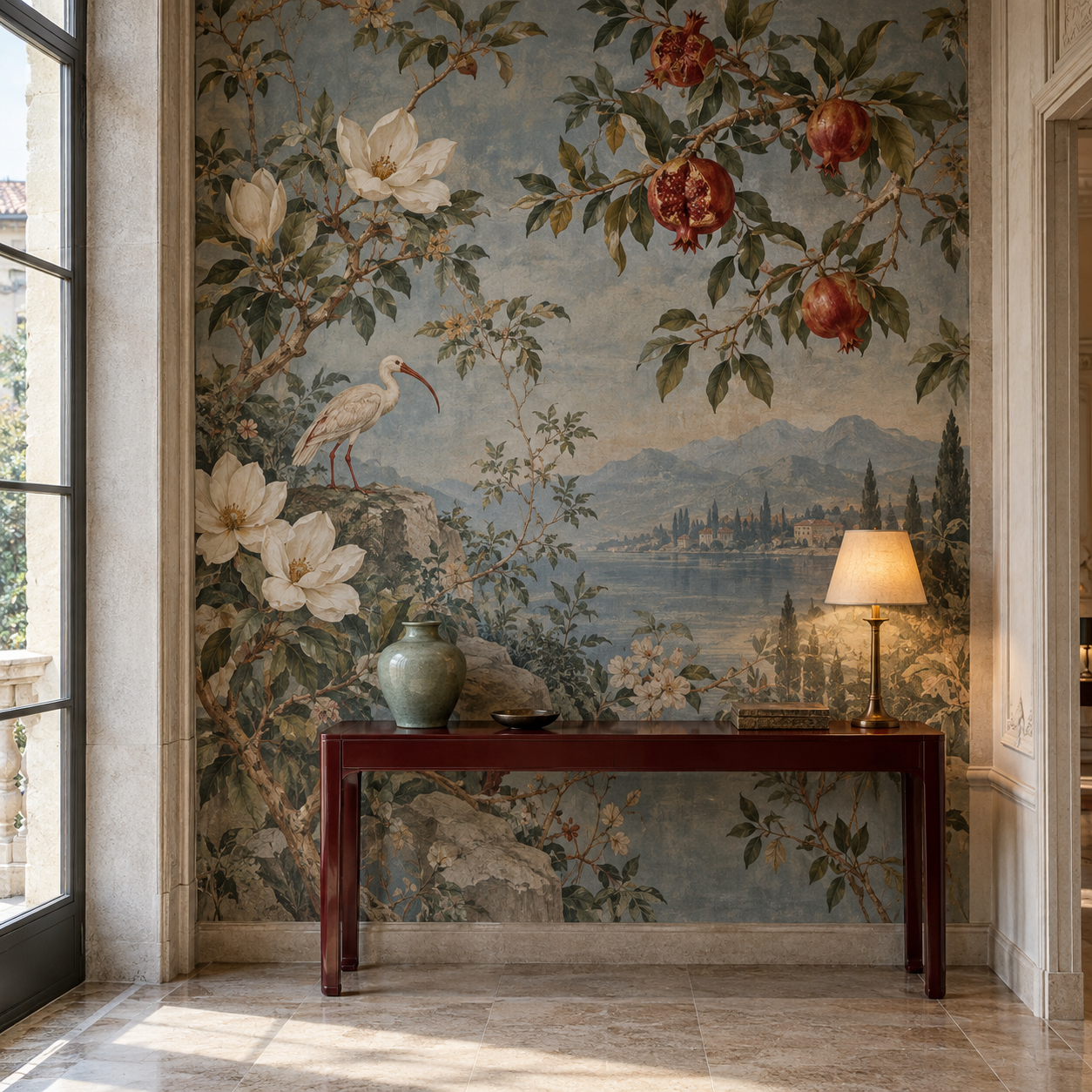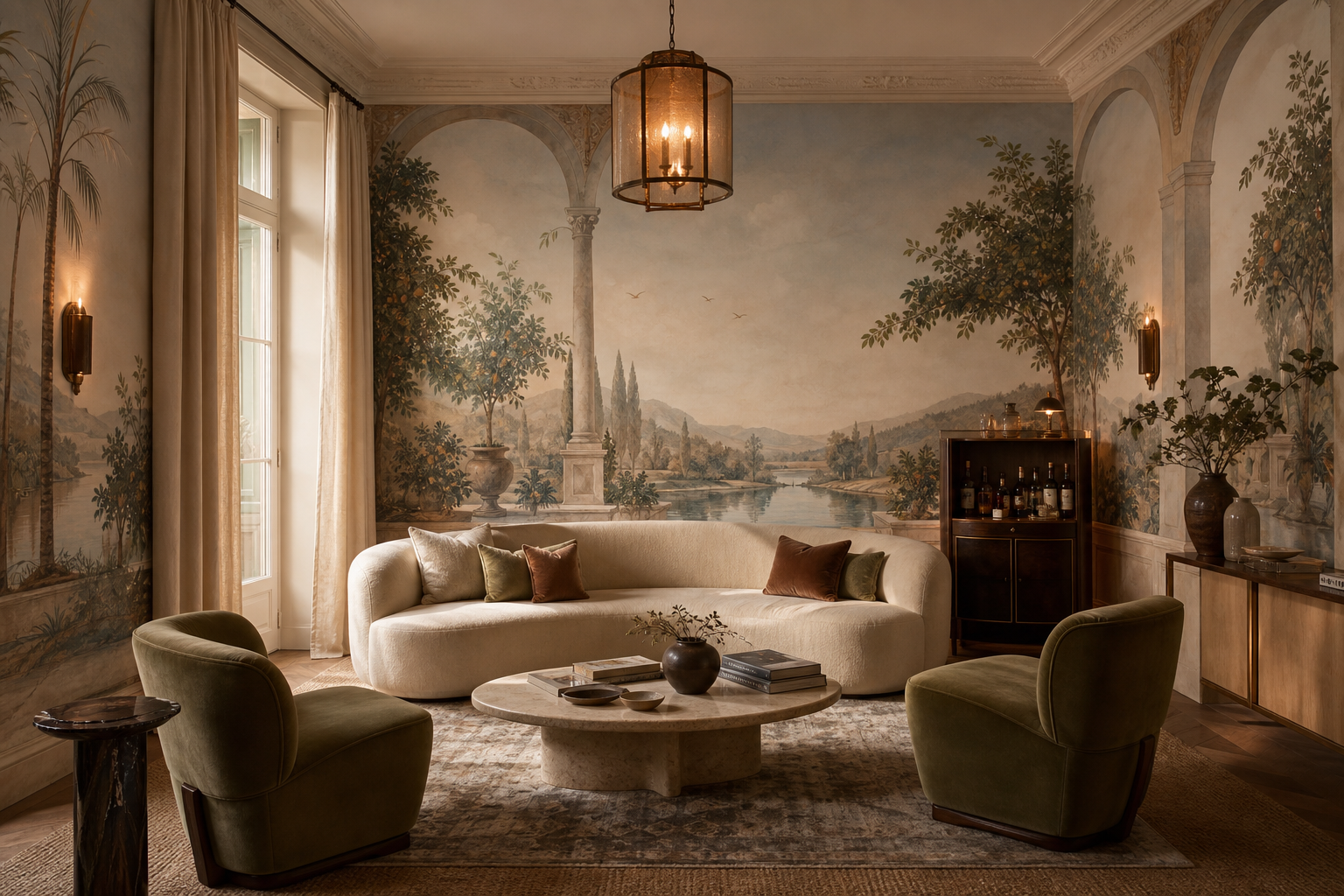
The Social Landscape: Luxury Wall Murals for Living Rooms
By Noora Al Hashemi · Published July 31, 2026
The Living Room Is Becoming a Salon Again
A living room is not at its best when it is merely arranged. It should gather people. It should know how to receive a friend at four, a client at six, a family at dusk, a guest who stays longer because the room has made lingering feel natural. This is why luxury wall murals for living rooms are so interesting to specify now. They can turn the largest social room in the house from a furniture plan into an atmosphere.
House Beautiful’s 2026 living room trend report describes the return of parlors, conversation zones, analog socializing and living rooms arranged for intention rather than passive television. That is precisely the language of the mural. A scenic wall can give the modern salon its setting: garden, loggia, grove, coast, city, ruin, dream. It can create the sense that the room has a view even when the architecture has not been so generous.
The opportunity is not simply to make a dramatic feature wall. That phrase has become too small for the task. A living room mural should behave more like weather, more like architecture, more like a host. It should establish where the eye rests, where conversation gathers, where the evening begins to lower its voice.
Begin With Conversation, Not the Feature Wall
The first mistake is to begin with the blank wall. Begin instead with the way people sit together. Is the living room formal or loose, low and enveloping or upright and ceremonial? Are guests meant to face one another, the fireplace, a view, a library wall, a drinks table, a piano, a garden door? Does the room host eight people once a week or two people every evening? These questions matter more than the prettiest sample in the folder.
A mural in a living room is always seen through use. It appears over the curve of a sofa, behind a lamp shade, beside the glint of a tray, above the shoulder of someone telling a story. It is reflected in a mirror, interrupted by curtains, softened by the hour, and sometimes half-lost behind a flower arrangement that no one admitted would be quite so tall. The composition must be generous enough to survive all of that.
I like to map the room in scenes. The arrival view from the door. The seated view from the principal sofa. The view from the drink being poured. The view after dinner, when the house has quieted and only lamps remain. If the mural improves each scene, it belongs. If it only impresses in the empty room, it has not yet understood hospitality.
A Mural Must Hold Several Distances
Living rooms are demanding because they operate at several distances at once. A powder room can be a jewel box, seen up close and all at once. A dining room is measured from the seated eye. A bedroom asks to be quiet from the pillow. But the living room changes constantly. One stands at the threshold, crosses the rug, sits near the wall, looks back from the opposite chair, and sees the mural again from the hall when leaving.
This is why scale must be tested with unusual discipline. A panoramic landscape can be magnificent behind a low sofa when the horizon sits above the back cushions and the central motif is not sacrificed to upholstery. A garden mural can make a corner chair feel like a destination if the branches are placed to frame, not crowd. A grisaille architectural scene can bring structure to a loose room, but only if its columns do not quarrel with real door casings and lamp stems.
The Musee du Papier Peint in Rixheim describes panoramic scenic wallpapers as landscapes formed from sheets that surround the room and transport the inhabitant imaginatively elsewhere. That word, surround, is useful. In a living room, the mural should not merely sit behind the sofa like a large picture. It should give the social life of the room a horizon.
Pattern, Texture and the New Collected Room
ELLE Decor’s 2026 living room trend coverage points toward interiors that are layered, expressive and individual without feeling performative. For specifiers, this matters because the living room is often where a client’s self-image becomes most visible. It contains inherited chairs, new upholstery, books, a tray from travel, a bronze lamp, a slightly eccentric table, perhaps one beloved object that refuses to match anything else. A mural has to join that biography, not flatten it.
Current wallpaper conversation is equally helpful. ELLE Decor’s wallpaper trends report describes wallcoverings moving toward atmosphere, emotion, tactile quality, hand-painted feeling and nuanced color. Those are exactly the qualities that keep a living room mural from feeling like spectacle. The surface should seem inhabited by the hand, by light, by time.
Texture is especially important. A matte scenic paper can make a salon feel more relaxed than a glossy statement. A silk or metallic ground may be ravishing if the room is dim, disciplined and lightly furnished. A textile-backed or fibrous ground can help the mural sit among upholstery and curtains rather than hovering separately from them. In a living room, richness is most convincing when the materials appear to be in conversation with one another.
Plan Around the Sofa, the Bar and the Lamp
The sofa is not a neutral object. It is a horizon, a wall, a social instrument and sometimes a very beautiful obstruction. Place it before placing the mural’s focal point. Draw the sofa height, side tables, lamps, sconces, curtains, bar cabinet, doors, art, speakers and switch plates on the elevation before approving scale. A central palm trapped behind a pendant cord, a bird landing on a lampshade, a colonnade cut by a curtain stack: these are not small accidents in a room designed for repeated looking.
Lighting deserves the same severity. Living rooms are rarely lit only one way. Morning light enters through curtains. Afternoon light rakes across the paper. Sconces come on before guests arrive. Lamps warm the corners. A pendant may turn into a small moon above the seating group. The mural should be judged in all of these conditions because it will be asked to host all of them.
Do not forget the bar, even when it is modest. A drinks cabinet, console or tray table often becomes one of the room’s small theatres. The mural behind it should tolerate bottles, glass, metal and movement. Foliage, sky, stone and water are forgiving here. A delicate figure, a perfectly placed bird or a central architectural motif may not be. The practical moments of hospitality should look intentional, not as if they have interrupted the art.
Which Mural Language Belongs in a Salon?
Different mural languages create different kinds of sociability. A landscape mural gives breadth. It makes the room feel more breathable and can soften a dense furniture plan. A garden or chinoiserie mural brings intimacy, especially when branches frame seating rather than descend too busily over heads. An architectural fantasy gives order and ceremony: loggias, arcades, ruins, terraces, distant pavilions. Grisaille gives extraordinary restraint, particularly when the room already carries color through rugs, books and upholstery.
Pierre Frey is a natural reference for living rooms because its world understands fabric, pattern, archive and upholstery as one conversation. A mural in that spirit can sit beautifully with curtains, cushions, skirted furniture, fringe and old chairs without becoming nostalgic in the wrong way. De Gournay is persuasive when the brief asks for hand-painted grace and a little shimmer. Zuber brings historical authority and the grandeur of scenic paper as decorative architecture; its official page for Eldorado records a panorama of 24 lengths, 1,554 woodblocks and 210 colors, a reminder that scenic wallpaper can be as serious a work of craft as any piece of furniture in the room.
Ananbo belongs when the client wants landscape as a dream, particularly a transported Mediterranean or tropical memory. Nobilis can offer Parisian tact and texture. Elitis may be right when surface, tactility and contemporary quiet matter more than narrative. Designers Guild, used with discipline, can bring joyful pattern into a family salon. The house is important, but the social temperature is more important. Choose the mural language that makes the room easier to inhabit.
Media Walls, Doors and the Art of Discretion
The modern living room often contains a negotiation no one wishes to discuss: the screen. Some clients insist it is not a television room, and then the largest black rectangle in the house appears above the chimney. Others have accepted media but want it handled with dignity. A mural can help, but only if the design is planned around the reality of the wall, not an imaginary version of the room.
If a screen must exist, it should be framed by quiet passages rather than placed over the most important part of the scene. If it can disappear into cabinetry, so much the better. If a projector is used, consider what happens to the mural when the lights dim and the wall temporarily changes purpose. Speakers, sensors, outlets, air grilles and picture lights must also be placed early. They are small only until they cut through the wrong branch.
This is where the living room connects with our earlier article on luxury wall murals for home offices. Both rooms ask the mural to coexist with function. A study has screens, books and concentration. A living room has screens, lamps and sociability. In both cases, elegance depends on acknowledging the equipment without letting it write the room’s story.
A Specifier's Checklist for the Social Room
A practical checklist, then. First, draw the seating plan before selecting the mural scale. Second, identify the four main views: arrival, principal seat, secondary seat and evening lamp view. Third, place every lamp, sconce, curtain stack, switch, outlet, speaker and cabinet on the elevation. Fourth, test the sample beside the actual upholstery, rug, metal finishes and curtain fabric.
Fifth, decide whether the room wants one panoramic horizon, a wrapped landscape, a framed panel sequence or a quieter mural contained within moulding. Sixth, consider the lower wall. Living rooms have chair backs, children, dogs, shoes, drinks, luggage and hands. A dado, wainscot or painted base can protect the mural and give the composition a graceful architectural footing. If the mural descends to the floor, specify finish and maintenance with open eyes.
Seventh, protect future continuity. Keep spare panels, record batch and production details, photograph the approved elevation, save paint and fabric references, and note how the installer handled corners, doors and seams. Luxury is not only the first beautiful evening. It is the ability to preserve that evening’s atmosphere for years without panic.
The Room That Keeps Its Guests
The finest living room murals do not demand constant admiration. They do something subtler. They make the room feel ready to receive life. They give conversation a setting, silence a background, lamps a surface to flatter, and furniture a reason to gather. They make a guest feel that the house has considered not only where one sits, but how one feels while sitting there.
That is why the living room may be the most revealing place for a mural. It is public enough to carry character and private enough to hold memory. It sees books left open, a tray not yet cleared, flowers slightly past their first day, children passing through, friends lowering their voices, someone alone with tea after everyone else has gone. The mural must be dignified enough for guests and forgiving enough for life.
So choose slowly. Walk the room at different hours. Sit in every chair. Turn on the lamps. Imagine the first glass and the last goodbye. Ask whether the scene gives the room depth without vanity, identity without performance, beauty without noise. When the answer is yes, the living room becomes what it was always meant to be: not a display of taste, but a social landscape.