The Powder Room Test: Luxury Wall Murals for Small Rooms with Big Atmosphere
By Seraphina Bellweather · Published July 16, 2026
The Smallest Room Can Carry the Boldest World
Powder rooms are often described as jewel boxes. I do not object to the phrase, provided we remember what a jewel box actually does. It concentrates pleasure. It makes a small volume feel deliberate, precious and complete. Nothing in it is accidental, because there is nowhere for accident to hide.
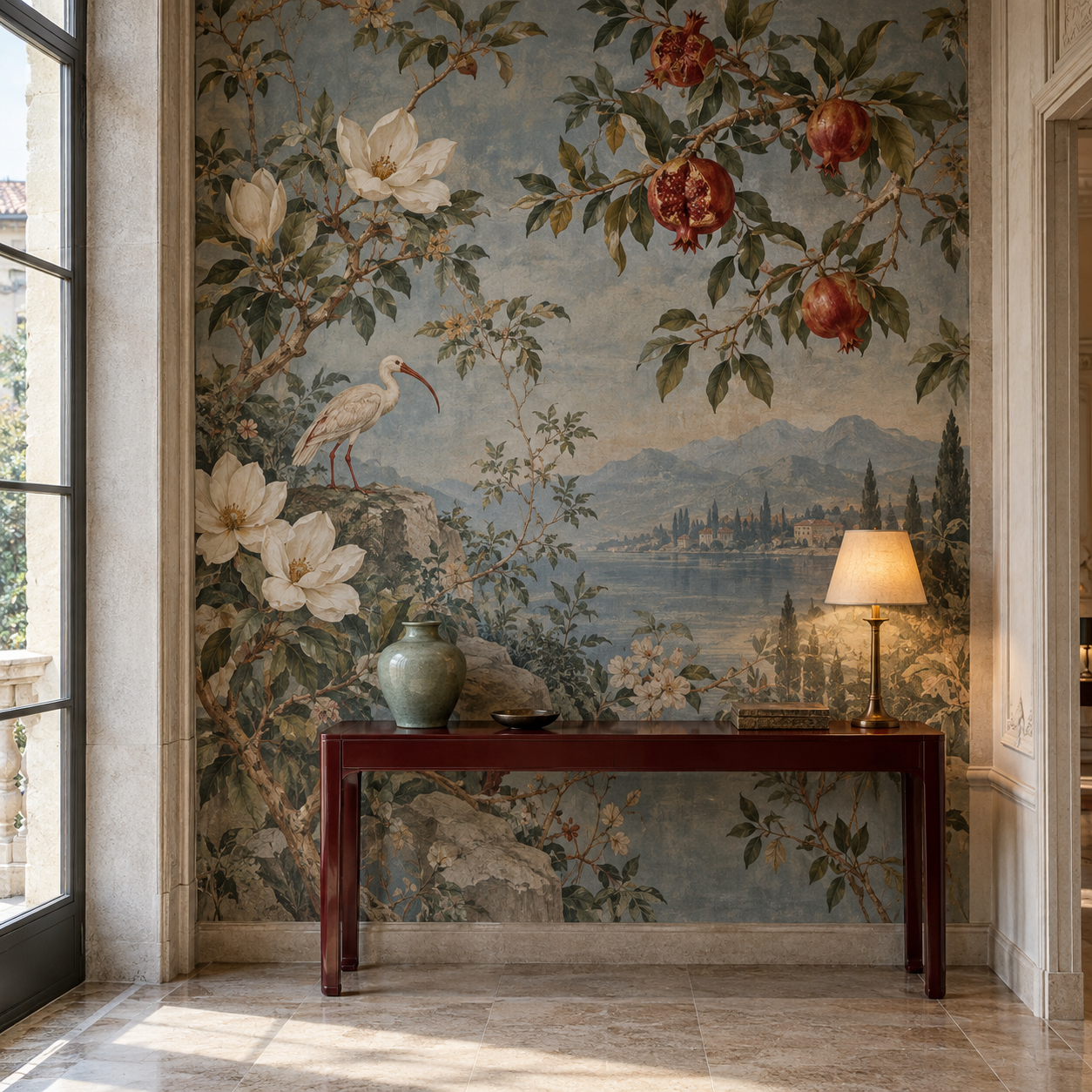
This is why luxury wall murals for powder rooms can be so persuasive. A mural gives the room a world before the visitor has had time to inventory the fittings. One opens the door and enters a moonlit garden, a misted lake, a chinoiserie grove, a painted ruin, a blue-and-white fragment of an imagined coast. The room may be no larger than a dressing alcove, yet it can feel as though it contains distance, weather and memory.
That is the pleasure. A powder room does not ask for the daily endurance of a bedroom or the social stamina of a drawing room. It is encountered briefly, sometimes theatrically, often by guests. It can therefore carry a higher note: deeper colour, sharper wit, more atmosphere. But the best examples are never merely bold. They are exact. In a small room, luxury is not abundance. Luxury is the sensation that every inch has been edited.
Why Powder Rooms Invite Wallpaper Courage
The design world has long understood that powder rooms permit a kind of decorative courage that larger rooms can make difficult. ELLE Decor’s survey of designer-approved powder room wallpapers treats these small spaces as natural stages for statement patterns and memorable atmosphere. That instinct is right. A powder room is a place where a client may say yes to the scenic, the moody, the botanical or the fantastical without fearing that the entire house has changed temperament.
Still, courage needs direction. A mural is more demanding than a pattern repeat because it has composition. It asks where the eye should travel, which details deserve intimacy and what kind of world the room will imply. A powder room mural should not feel like a large landscape inconveniently squeezed behind a basin. It should feel as though the scene was waiting for precisely this architecture.
Begin, then, with mood rather than motif. Is this room a secret garden beside a formal dining room? A lacquered midnight pause off an entrance hall? A pale, misted interlude near a bedroom corridor? The answer should guide everything: the mural house, the ground, the scale of branches or architecture, the mirror shape, the metal finish and even the hand towel. The room is small enough for every element to become part of the same sentence.
Start With the First Glance
The first glance is the powder room’s most important moment. Unlike a sitting room, where one slowly discovers the scheme, this room announces itself in the opening of a door. The mural must decide what it wants to reveal immediately and what it would rather withhold for the second look.
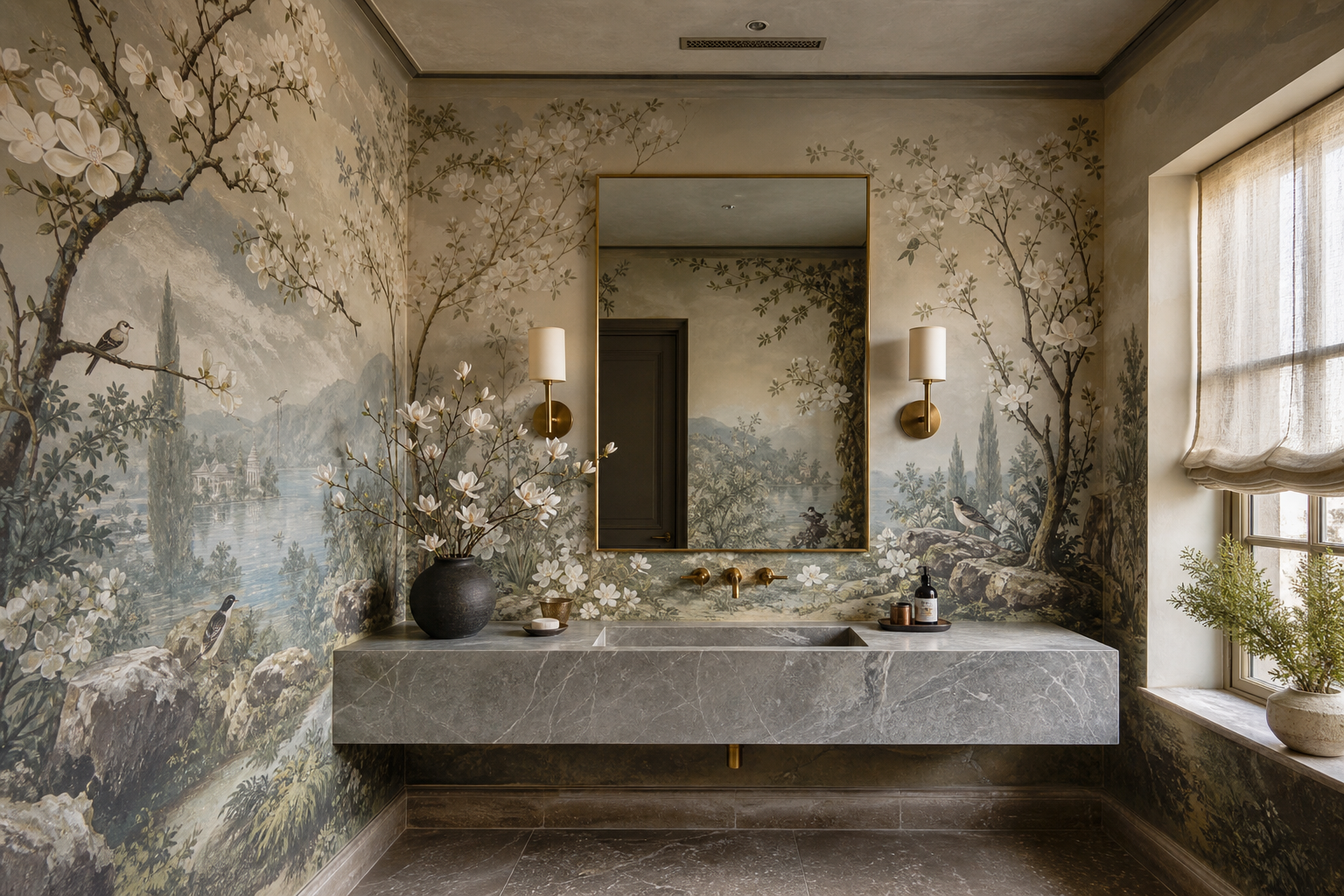
A wall opposite the door can carry the establishing view: a tree rising behind the vanity, a distant pavilion, a painted bank of clouds, a sweep of foliage dissolving into pale water. If the basin wall is the first view, the mural must negotiate the mirror with particular grace. The mirror is not simply an interruption; it is a frame, a cut, sometimes almost a second picture. A badly placed motif will feel decapitated. A well-placed branch or horizon can make the whole room seem designed around reflection.
This is where our earlier thoughts on trompe-l’oeil become useful, though the effect here is gentler. The powder room mural does not need to deceive. It needs to extend. It should make a compact room feel as if it has a view, a depth, perhaps even a private weather of its own.
Let the Mirror Join the Composition
Mirrors are merciless collaborators. They double whatever is beautiful, but they also double every weak decision. A seam becomes more visible in reflection. A crowded motif becomes twice as crowded. A bird placed at the wrong height may appear to perch on a guest’s shoulder. A dark scenic passage reflected in a narrow glass can make the room feel smaller than it is.
For that reason, the mirror should be chosen with the mural, not after it. A slim brass rectangle may discipline a romantic garden; a softly arched mirror may suit a landscape with distant architecture; an antiqued or smoked mirror can turn a dramatic scenic paper into something more nocturnal. Wall lights should be equally integrated. Their shades, backplates and glow become foreground objects against the mural, almost like actors crossing a painted set.
In the most successful rooms, reflection is the quiet reward. The visitor sees the mural directly, then again behind them, altered by glass and light. This doubling is one of the reasons powder rooms can feel so memorable. They are small, but they allow a designer to choreograph the viewer from several angles within a few steps.
Scale, Colour and the Discipline of One Idea
Scale is the great test of taste. Tiny motifs can become fussy in a powder room because one is standing so close to them. Enormous motifs can be magnificent, but only if the room can tolerate their confidence. A single magnolia branch, one crane, a pale architectural fragment or a sweep of grisaille trees may do more than a crowded panorama trying to perform every decorative trick at once.
Architectural Digest’s interview with Martyn Lawrence Bullard on decorating with wallpaper includes advice that remains especially useful here: small rooms such as powder rooms can be an excellent place to begin, and committing to the whole room is often stronger than treating wallpaper as a timid accent. For murals, that commitment may mean wrapping the room so the scene feels immersive rather than pasted onto one wall.
Colour requires the same discipline. A powder room can carry emerald, aubergine, lacquer red, tobacco, indigo or celadon beautifully, but it rarely benefits from indecision. Choose one governing atmosphere. A moon garden wants silver, charcoal and green-black. A Mediterranean fragment may want chalk, olive and faded sky. A chinoiserie room might live in tea paper, blossom pink and antique gold. The scheme should feel concentrated, not crowded.
Which Mural Language Belongs Here?
Different mural languages suit different powder rooms. Zuber & Cie brings historical gravity and the romance of panoramic paper; it is especially compelling in houses where architectural memory matters. De Gournay can make the room feel like a private cabinet of hand-painted birds, branches and silk. Ananbo is persuasive when the client wants landscape as dream rather than display: mist, distance, ruins, palms, rivers, softened horizon. Pierre Frey may add French wit or archival richness; Nobilis can bring cultivated restraint; Elitis may be right when texture should speak more quietly than scene. Designers Guild, used with control, can make a powder room joyful without making it frivolous.
The point is not to choose the most famous house. It is to choose the visual intelligence the room requires. A guest powder room beside a formal salon may ask for theatrical polish. A family powder room near a garden door may want something fresher and less ceremonial. A city apartment cloakroom might need depth more than colour. A country house may ask for a mural that seems to have belonged there longer than the plumbing.
If you are drawn to chinoiserie, the considerations in our piece on the world’s most coveted chinoiserie walls apply beautifully here: surface, hand, light and narrative all matter. The powder room simply compresses those pleasures into a more intimate scale.
Samples, Light and the Last Inch of Luxury
The final decision should never be made from a small digital image. Wallpaper is experienced in light, at scale, beside stone, metal, mirror and skin. Veranda’s recent piece on Martha Stewart’s wallpaper rules gives sensible design-facing advice: decide the mood, choose quality, consider scale, bring samples home and balance the surrounding room. Those rules may sound simple, but in a powder room they become exacting.
Order samples. Tape them where the mural will actually live. Look at them in morning light, evening light and under the sconces. Place the metal finish beside them. Hold up the towel, the stone, the paint for the ceiling. If the mural has a sheen, check it from the doorway and in the mirror. If it is matte, make sure the lighting gives it life rather than leaving it flat. A powder room is too small for almost-right.
And then, having done all this careful looking, allow the room its fantasy. That is the reward for discipline. A powder room mural can be romantic, witty, mysterious or ravishingly pretty. It can give a guest the smallest possible journey: one step through a door and suddenly elsewhere. For an interior designer, that is no minor achievement. It is proof that atmosphere does not depend on square footage. It depends on conviction, proportion and the rare confidence to make a small room unforgettable.