The Room That Seasons the Meal: Restaurant Wall Murals for Private Dining and Hospitality
By Noora Al Hashemi · Published September 8, 2026
The Dining Room Is Part of the Dish
A restaurant is judged first by the mouth, naturally, but rarely remembered by the mouth alone. We remember the low lamp beside the table, the first glimpse of the bar, the sound level just before the room fills, the way a server crosses the floor, the texture under the hand, the view behind the person we are trying to impress. Restaurant wall murals belong to this wider choreography. They do not season the food, but they can season the meal.
This is why murals deserve more serious attention in luxury restaurant design and private dining rooms. A mural can give an interior a sense of place before the menu has been opened. It can make a narrow room feel destination-worthy, a basement room feel less enclosed, a hotel restaurant feel less interchangeable, or a private room feel as though it has a secret history.
The mistake is to treat the mural as a photogenic wall. Restaurants already have enough things designed for quick photographs. A fine dining room needs something slower: an atmosphere that improves over two hours, survives candlelight, accepts movement, flatters skin, holds conversation and leaves the guest with a memory that cannot be reduced to a plate.
Hospitality Wants Memory, Not Merely a Backdrop
The National Restaurant Association’s 2026 State of the Restaurant Industry describes a market still pushed by demand to dine out, while also warning that operators must answer pressure with creativity, value and the experiences customers seek. That matters for designers because hospitality interiors are no longer allowed to be merely pleasant. They have to justify the decision to leave home.
DLR Group’s hospitality outlook for 2026 makes a related point in design language, noting the pull toward experiences that feel intentional, surprising and uniquely personal. A mural is exceptionally useful here because it can carry identity without requiring the restaurant to become a theme. It can suggest a coastline, a garden, a voyage, a city, a historical mood or an imagined private house, while still leaving the chef and the service to remain the centre of the evening.
For restaurants, this is the difference between decoration and atmosphere. Decoration is what a guest notices while waiting for the first drink. Atmosphere is what makes the guest order another one. A mural should not be an accessory added once the dining room is already complete. It should be part of the room’s argument for why this table, tonight, was worth choosing.
A Mural Can Give a Restaurant Its Private Weather
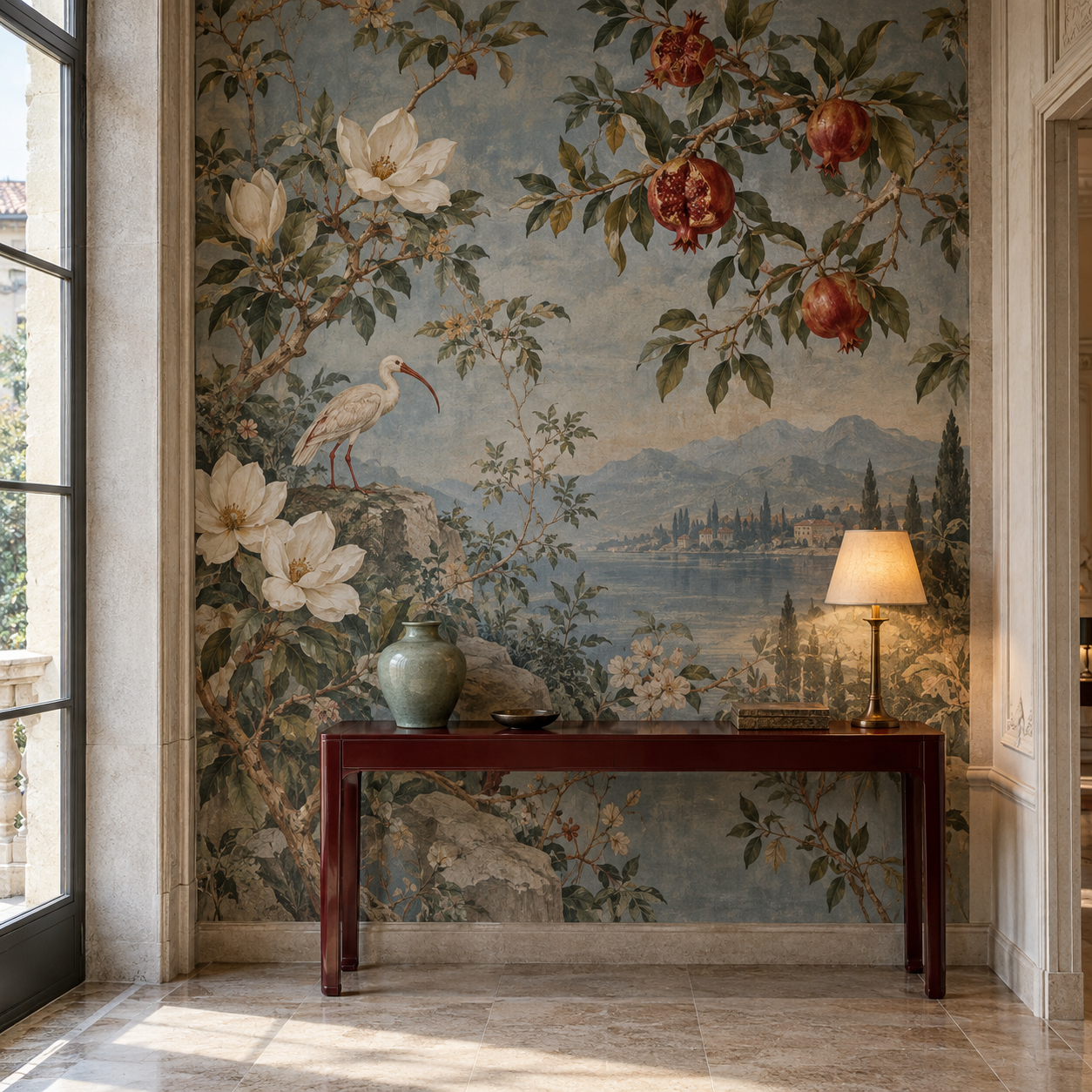
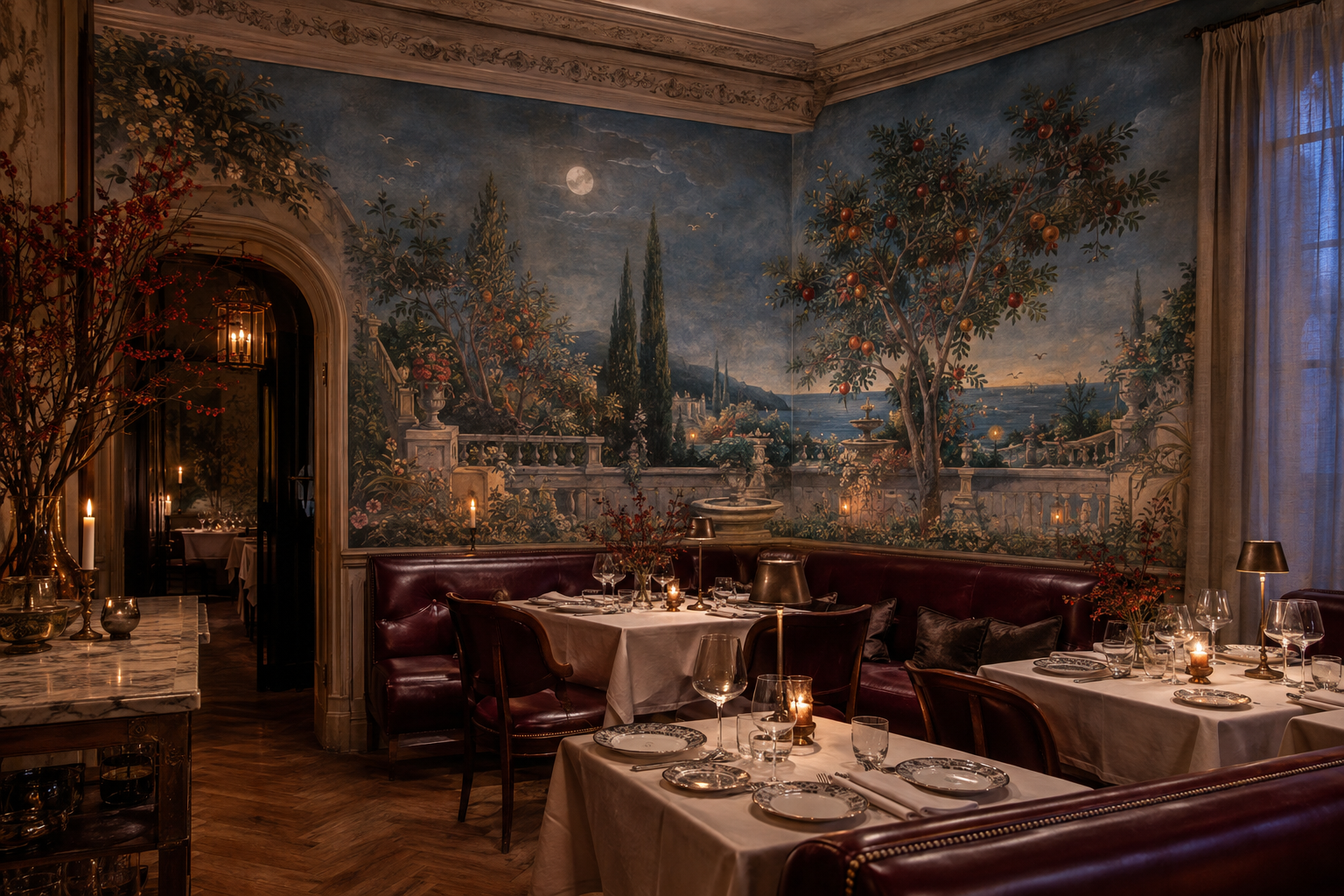
The best restaurant murals behave like weather. They change with the hour, with the number of candles, with the tone of the room, with the colour of wine in the glass. A moonlit garden at dinner can feel entirely different from the same mural seen in the pale discipline of morning breakfast service. A coastal panorama may be fresh at lunch and almost private at night. A chinoiserie garden may read as joyful in the bar and intimate in the banquette corner.
The MICHELIN Guide’s piece on nature-focused restaurants is useful because it treats nature not as garnish but as something that can complement a world-class meal: open space, woodland hush, ocean lull, verdant rooms and views that give the diner a sense of place. A mural can participate in that same desire even when the restaurant has no actual view. It can lend an urban room a river, a mountain, a walled garden, a night sky, a grove of pomegranates, a little distance beyond the table.
This is not dishonest. It is hospitality. Restaurants have always been places where reality is composed with care: lighting corrected, linen pressed, sound softened, flowers refreshed, the ordinary city held outside for a few hours. A mural can make that composition visible. It says the room has decided what kind of evening it wants to give.
Design for the Seated Eye
Restaurant murals must be designed from the chair, not the doorway. The standing view matters, of course, especially for arrival and photography, but the dining room is mostly experienced at table height. A guest sits, turns, leans, listens, reaches for a glass, looks past another person’s shoulder and lets the room become a kind of blurred companion. The mural must work within that human scale.
Place the horizon with the banquette in mind. A beautiful distant waterline that disappears behind a sitter’s head will not help the room. A bird placed where a sconce throws glare may become irritating. A central tree trunk behind the principal table can be splendid or absurd depending on its width and exact position. A dramatic motif that looks marvellous on the empty elevation may spend service blocked by a floral arrangement, waiter station or chair back.
Our earlier essay on luxury wall murals for dining rooms considered the private house. Restaurants make the same questions less forgiving. Furniture moves. Tables combine. Service paths widen and narrow. Guests bring coats, bags, phones, celebrations and unpredictable gestures. A mural for hospitality should be composed for life in motion, even when the desired mood is stillness.
Private Dining Needs a Different Kind of Drama
Private dining is where the mural can become quietly powerful. The public restaurant may need recognisable energy, but the private room needs confidence, discretion and a sense that the occasion has been held apart. Too much spectacle makes the guest feel as if the room is performing for social media. Too little atmosphere makes the private room feel like a rentable appendix.
A mural solves this beautifully when it creates enclosure without heaviness. A garden terrace can make a windowless room feel gracious. A grisaille architectural landscape can give a board dinner seriousness without turning it into an office. A silk ground with branches and night birds can make a birthday dinner feel rare without announcing luxury too loudly. The wall gives the room its invitation: stay, speak, linger, lower the voice.
The most successful private dining rooms also understand that privacy is sensory, not only spatial. A door helps, but so do soft surfaces, calm lighting, generous chair spacing and a mural that gives the eye somewhere to rest between conversations. People disclose more when a room feels held. That is not decoration. That is hospitality intelligence.
The Beautiful Room Must Still Work
There is a practical discipline beneath all this romance. The WELL Building Standard’s Comfort concept reminds us that indoor comfort includes acoustic, olfactory, ergonomic and thermal conditions. For restaurants, that is not an abstract concern. The most beautiful mural in the world will not save a room where guests cannot hear one another, smell the service station, overheat beside glazing, or sit under lighting that turns everyone grey.
Wallcovering can help, but it cannot be asked to solve everything. Acoustic planning, ceiling treatment, upholstery, curtains, rugs, table spacing and mechanical noise all matter. The mural ground must also be chosen for the restaurant’s use: cleanability, abrasion resistance, flame requirements, substrate preparation, edge protection, adhesive compatibility, humidity, kitchen adjacency and the simple fact that chairs, bags and servers will meet the lower wall every day.
This is where luxury sometimes reveals itself most clearly. Not in choosing the most elaborate scene, but in specifying the correct material so the scene can survive the life of the room. A restaurant mural should look romantic at eight o’clock and still look cared for after a thousand covers. Beauty that cannot withstand service becomes expensive fragility.
Which Mural Language Belongs at the Table?
De Gournay is a natural reference for restaurant and private dining murals because its hand-painted language understands ceremony, detail and the flattering power of a luminous ground. Birds, branches, gardens and atmospheric colour can make a hospitality room feel personal rather than branded, especially when the palette is adjusted to candlelight and upholstery. The danger is excess, but in the right hands excess becomes generosity.
Zuber brings a different authority: scenic paper as architecture, panorama as event, history as presence. It belongs when the dining room can accept grandeur without becoming museum-like. Ananbo is persuasive when the brief asks for dreamlike distance, Mediterranean memory or tropical escape handled with softness. Pierre Frey can be invaluable when the room needs textile intelligence around banquettes, curtains and upholstery. Nobilis and Elitis can bring texture and restraint where the menu, service or architecture already carries the drama. Designers Guild can work beautifully where colour and confidence are part of the restaurant’s voice.
The choice should begin with the hospitality promise. Is the restaurant trying to feel like a hidden garden, a cultivated apartment, a coastal dining room, a collector’s salon, a members’ club, a jewel box, a grand cafe, a room of travel, a room of local memory? The mural should answer that promise with enough clarity that the guest feels it, but enough subtlety that dinner remains dinner.
A Specifier's Checklist for Restaurant Wall Murals
A practical checklist, then. First, define the restaurant’s emotional promise in verbs: gather, seduce, shelter, celebrate, slow, transport, sharpen, soften, remember. Second, map the guest journey: street, host stand, bar, threshold, principal table, banquette, private room, washroom, exit. Decide where the mural should announce, where it should recede and where it should reward attention.
Third, draw the elevations with real restaurant life included: table sizes, chair backs, banquettes, sconces, art lights, waiter stations, POS points, mirrors, curtains, emergency signs, vents, speakers, door swings and corner guards. Fourth, test the mural under operating light, not studio light. Candlelight, dimmed LEDs, daylight lunch, evening service and cleaning light will all tell different truths. Fifth, choose the substrate and protection strategy before falling in love with the image.
Sixth, coordinate sound, scent and temperature. A mural can hold the eye, but the room must hold the body. Seventh, decide whether the wall should carry local reference, culinary reference or pure atmosphere. Literal food imagery rarely ages well. A garden, coast, orchard, terrace, woodland, river, architectural capriccio or abstracted textile landscape will often be more generous. Eighth, keep a record: artwork, colour approvals, batch references, installer notes, spare panels and maintenance instructions.
Let the Wall Hold the Evening
The restaurant wall has a particular responsibility. It is present at proposals, anniversaries, business dinners, awkward reconciliations, solitary lunches, birthday toasts and the small private theatre of choosing dessert. It sees guests at their most observant and their least guarded. It should therefore do more than provide a background. It should hold the evening.
A fine mural can give a restaurant the thing every operator wants and every designer hopes to create: a memory that belongs to the room. Not a slogan, not a gimmick, not an image that overwhelms the food, but a climate in which hospitality feels inevitable. The guest may not describe the mural precisely afterward. She may only say the room felt like somewhere.
That is enough. In the hierarchy of luxury, recognition is not always the highest prize. Sometimes the real achievement is quieter: a table that feels chosen, a wall that lets conversation deepen, a room that seems to season the meal without touching the plate.