The Grand Ascent: How to Choose a Luxury Wall Mural for a Staircase
By Geneviève Ashworth
Every Staircase Is Already a Story
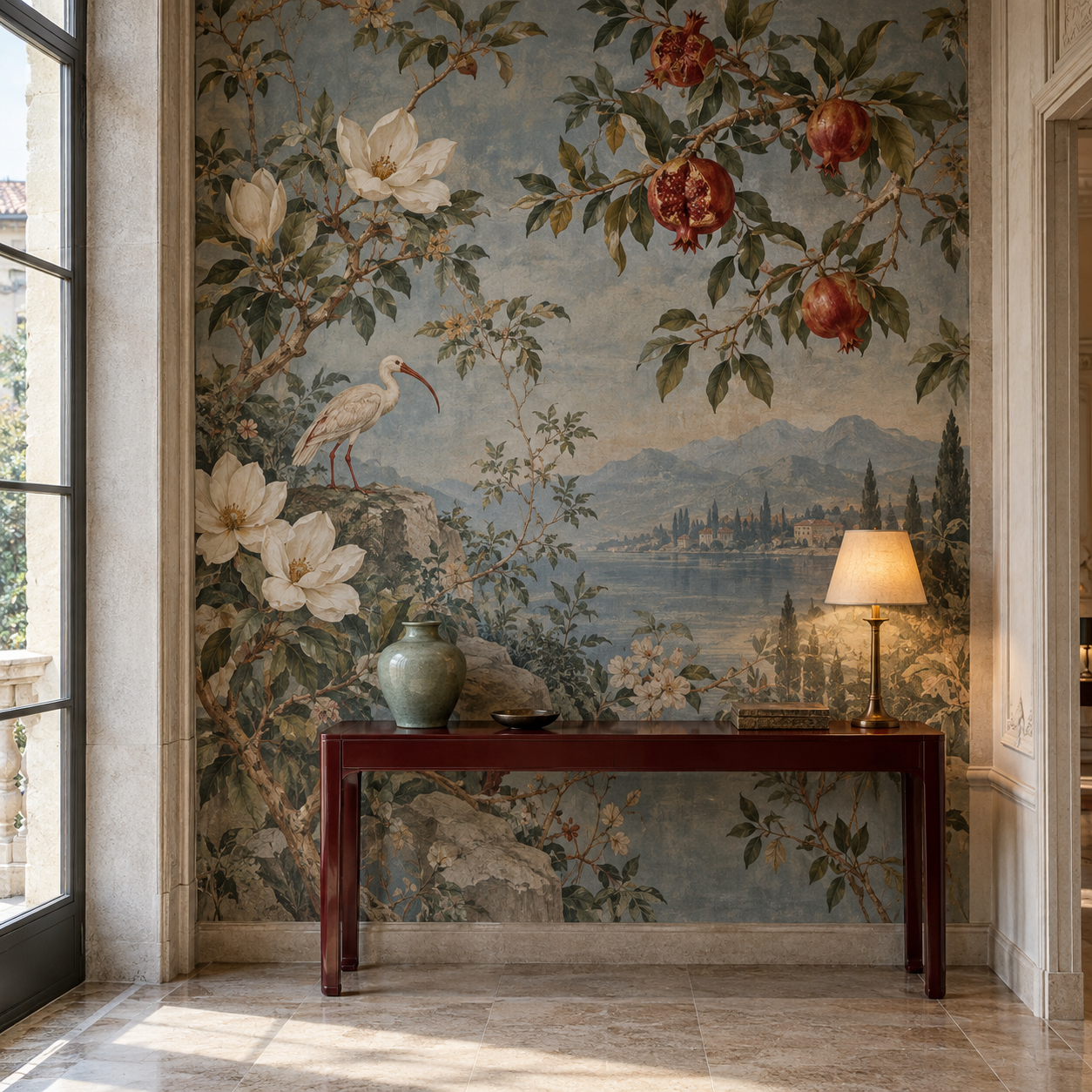
My dears, a staircase is never merely a way of getting from one floor to another. It is an entrance, an interval and a reveal, all in one architectural gesture. We encounter it in motion: first as a promise from the hall, then as a procession of changing viewpoints, and finally as a last backward glance from the landing. No ordinary room offers quite the same sequence. This is precisely why a luxury wall mural for a staircase can be so powerful. It does not sit politely behind the furniture. It travels with us.
For years, stair halls were treated with an almost reverential restraint: perhaps a procession of portraits, a dignified runner and a chandelier suspended at a suitably impressive height. All lovely, certainly, but a panoramic mural can do something those individual objects cannot. It can gather the entire vertical volume into one world. A landscape rises with the handrail; a branch appears to cross the landing; a distant horizon draws the eye through the upper gallery. Architecture stops feeling like a stack of levels and begins to read as one continuous scene.
The effect should not be confused with simple spectacle. The finest staircase murals do not shout from every angle. They reveal themselves gradually, which is a far more luxurious pleasure. Like a beautifully designed film set, the space understands where the visitor will stand, what the eye will discover next and when the full composition should finally be allowed to appear.
Design for the Moving Eye
A mural seen from a sofa is a relatively stable picture. A staircase mural is closer to cinema. The viewer approaches it, passes beside it, looks up through it and sees it again from above. Designing for that moving eye is the first and most important decision.
Begin at the bottom of the stairs. This is the establishing shot. What should be visible from the entrance hall: an open sky, a remarkable tree, a pavilion, a distant mountain? The strongest element need not sit in the geometric centre of the wall. It should occupy the visual centre of the arrival. That distinction is everything. Our earlier thoughts on murals that make an entrance apply here too, but a staircase adds suspense. One should see enough to be seduced, not enough to exhaust the story.
Then consider the ascent. A successful composition offers smaller discoveries at eye level: a bird in the foliage, a change in cloud, a fragment of architecture, the glint of imagined water. These details reward proximity without turning the mural into a decorative puzzle. At the upper landing, the view reverses. Elements that appeared distant below may suddenly become intimate, while the lower hall becomes part of the picture. The mural must survive that reversal. Ask for elevations and scaled visualisations from both directions, not simply one handsome frontal rendering.
Choose the Scene Before the Colour
Clients often begin with colour. I understand the temptation; colour feels immediate and reassuring. Yet for a staircase, the more consequential choice is the type of world one wishes to enter.
A landscape panorama creates distance and air. It is especially effective in a tall, narrow stairwell because a low horizon and layered perspective can make the architecture feel broader than it is. A botanical or chinoiserie composition behaves differently. Its branches, birds and blossoms can climb naturally with the stairs, creating intimacy rather than distance. Architectural capriccios – colonnades, terraces, ruins and fanciful pavilions – lend rhythm to formal staircases, while grisaille or sepia scenes introduce narrative with a quieter voice. They are particularly useful when the balustrade, stone or joinery already carries strong colour.
Scale is the quiet arbiter. Tiny motifs can become restless across a double-height wall; one spends the entire ascent looking at repeat rather than scene. Conversely, a single enormous foreground tree may overpower a modest staircase and make every landing feel like an encounter with its trunk. I prefer a hierarchy: one or two grand forms, a calm middle distance and enough open atmosphere for the architecture to breathe.
And do resist the urge to fill every available inch with incident. A pale sky, misted valley or stretch of water is not empty space. It is visual silence, and on a staircase – where rails, doors, landings and light fittings already create their own lines – silence is indispensable.
Compose the Mural Around the Architecture
Now we come to the deliciously practical part: making the image obey the building. Before a design is approved, mark every interruption on a proper elevation – stringers, handrails, dado rails, door heads, radiators, switches, sconces and the precise line of each landing. A staircase mural should be composed around these elements, never sacrificed to them.
There are three natural anchors. The first is the lower arrival, where the scene introduces itself. The second is the turn or half-landing, which often deserves a moment of focus: a pavilion glimpsed through trees, perhaps, or a widening river. The third is the upper landing, where the composition should resolve without feeling abruptly cropped. On a straight flight, these anchors form a diagonal rhythm. On a curved or spiral staircase, they must be considered as a sequence of overlapping views.
Light deserves its own elevation. A high window can make pale silk or metallic grounds glow, but direct sun may also flatten delicate colours at certain hours. Wall lights should illuminate atmosphere rather than puncture faces, birds or architectural details. If a pendant hangs through the centre of the stairwell, treat it as part of the composition – almost a celestial object within the scene. The same principle governs the return of the decorated fifth wall: lighting, architecture and image must join the same choreography.
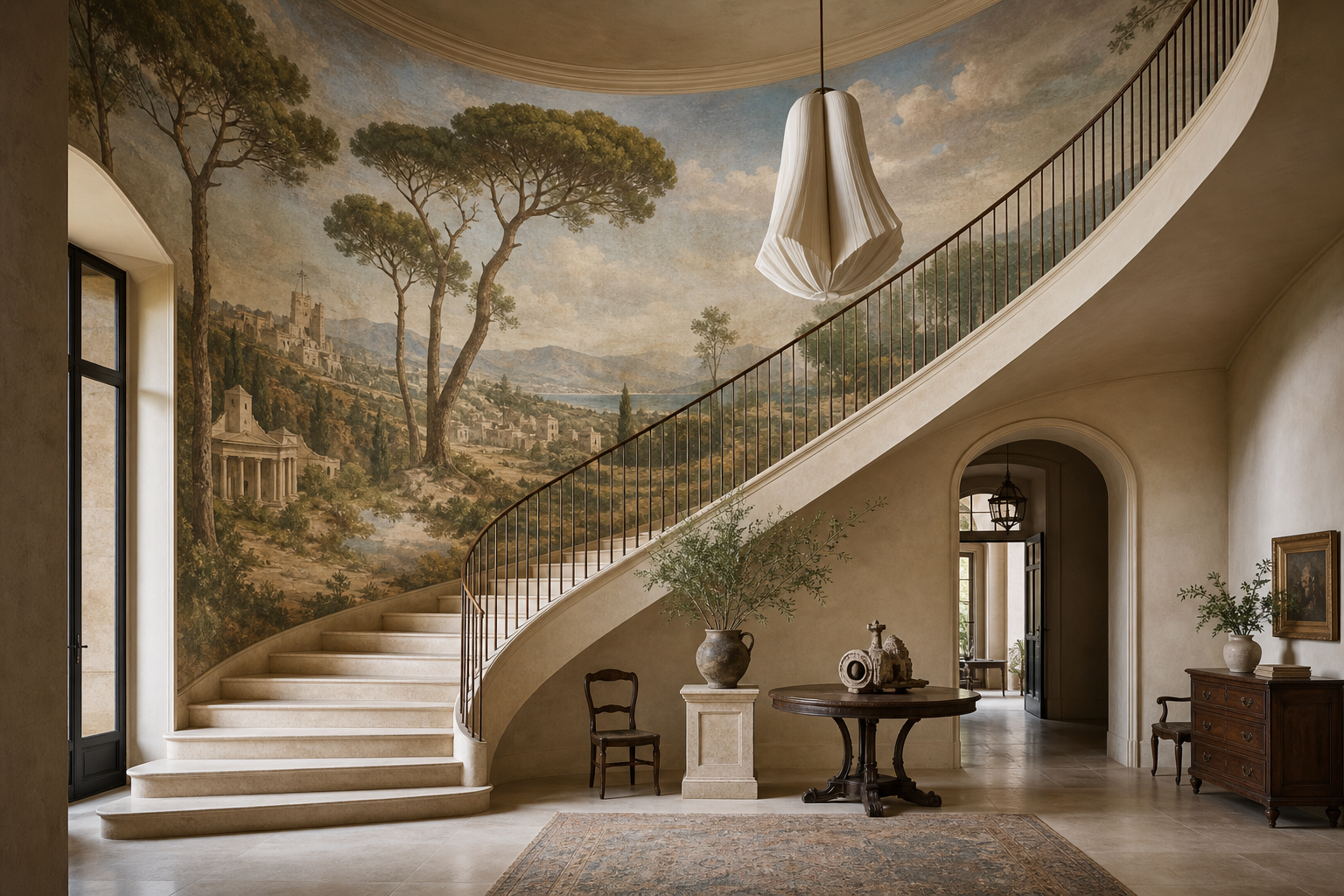
At the bottom step, the best mural offers invitation. Halfway up, it offers intimacy. From the landing, it offers completion. Those three experiences need not be identical. In fact, they should not be. A landscape may begin with shadowed foliage, open into a luminous middle distance and finish with sky. A garden may place its densest flowering near the turn, where one pauses naturally. A monochrome scene may reserve its darkest values for the lower level and grow progressively lighter as it climbs.
This is also where the staircase itself can be allowed to frame the art. A finely drawn bronze balustrade against a soft grisaille mural creates a moving foreground of its own. Dark timber can steady a pale, romantic panorama; limestone steps can cool a warm sepia landscape. The runner should support the scene rather than compete with it. If the mural is richly coloured, I favour a quiet wool or restrained border. If the walls whisper in monochrome, the runner may be permitted a deeper note.
Do not forget the wall beneath the stair or the sliver visible beyond a floating flight. These apparently secondary areas are often conspicuous from the opposite landing. A made-to-measure composition can extend the atmosphere into them without forcing the main subject into awkward fragments. The goal is not to cover more surface. It is to ensure that every visible surface belongs to the same world.
The Great Houses and the Grand Ascent
The great wallcovering houses offer very different routes to this effect. Zuber’s historic panoramas bring extraordinary breadth and narrative authority. Its celebrated Eldorado, for example, extends across 24 lengths and is still printed with 1,554 antique woodblocks carved in 1848. Such a work can turn a generous stair hall into an inhabited landscape, but its fixed sequence demands exceptionally careful placement.
de Gournay’s Paris showroom demonstrates another possibility: its embroidered Nara design was installed on a custom curved wall encircling a spiral staircase. It is a beautiful reminder that a mural need not imitate a distant view to command complex architecture. A climbing composition can embrace the curve itself.
For projects that require greater flexibility, Ananbô’s made-to-measure panoramic murals offer a particularly useful design language. The house begins with hand-painted artwork, digitises it and prints on ultra-matte non-woven paper; certain decors can be ordered in selected strips and adjusted across substantial widths. A scene such as Tana Grisaille, with its distant volcanic silhouette and atmospheric depth, suggests how a tall circulation space might acquire drama without relying on loud colour.
The right choice is not simply the grandest name or the busiest design. It is the work whose composition, material and method can answer the actual staircase in front of you.
Installation Is Part of the Design
Here I must remove my set decorator’s hat for a moment and speak like a producer: involve the installer early. A stairwell is one of the least forgiving places to improvise. Heights change, access is difficult, walls curve, flights interrupt the hanging line and a small error in panel sequence can become a very tall error indeed.
The Wallcovering Installers Association’s training for murals and delicate scenic wallcoverings emphasises field verification, room layout, panel placement, wall preparation, adhesive selection and the handling of sensitive materials. Every one of those decisions belongs in the design conversation before production. For a staircase, add a safe access plan and a clear agreement on where seams will fall relative to the diagonal of the steps.
Ask the mural studio for a numbered panel map and a final elevation approved against site measurements. Confirm whether the design is supplied as fixed panels, selectable lengths or a fully scaled composition. Decide where trimming tolerance will be absorbed. Check that the wall is smooth, stable and properly prepared; luxury material cannot disguise poor substrate. If the stair is curved, request physical samples and discuss how the chosen ground behaves around the radius. Hand-painted silk, paper-backed textile and non-woven mural paper are not interchangeable simply because they all look exquisite in a photograph.
Most importantly, reserve enough material and time. The true extravagance is not waste. It is the calm created by planning so thoroughly that, on installation day, artistry is not forced to negotiate with panic.
The Staircase That Makes the House
A memorable staircase does more than impress a guest. It gives the house a sense of direction. We rise through its landscape in the morning, glimpse it from the hall during the day and descend through it under softer evening light. The mural becomes one of those rare decorative decisions that changes with both viewpoint and ritual.
That is why I would never choose a staircase mural from a small sample alone. A sample tells you about colour, hand and ground. It cannot tell you about narrative. Demand the full composition. Study it from below and above. Place the handrail over the elevation. Draw in the pendant, the window and every door. Then step back and ask the only question that truly matters: does this image make the act of moving through the house feel more beautiful?
When the answer is yes, the staircase ceases to be leftover architecture between important rooms. It becomes the house’s most elegant journey – a procession through painted distance, changing light and carefully timed revelation. One begins at the bottom with curiosity and arrives at the top having travelled somewhere. And really, my dears, if a wall can give us a journey without asking us to pack a single suitcase, why should we settle for mere decoration?
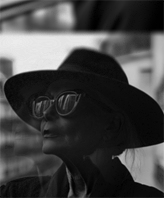
About the author: Geneviève
Born in the US to a French mother, Geneviève spent decades as a sought-after set decorator for European film and theatre productions, developing a storyteller’s eye for how environments shape narrative. Her extensive career demanded meticulous visual research into historical periods and translating abstract concepts into tangible, atmospheric sets – skills now focused on analyzing the impact of exceptional wallcoverings. Preferring quiet observation after years of collaborative, often uncredited, work, she now shares her unique perspective on visual drama and how murals act as compelling characters… Read more